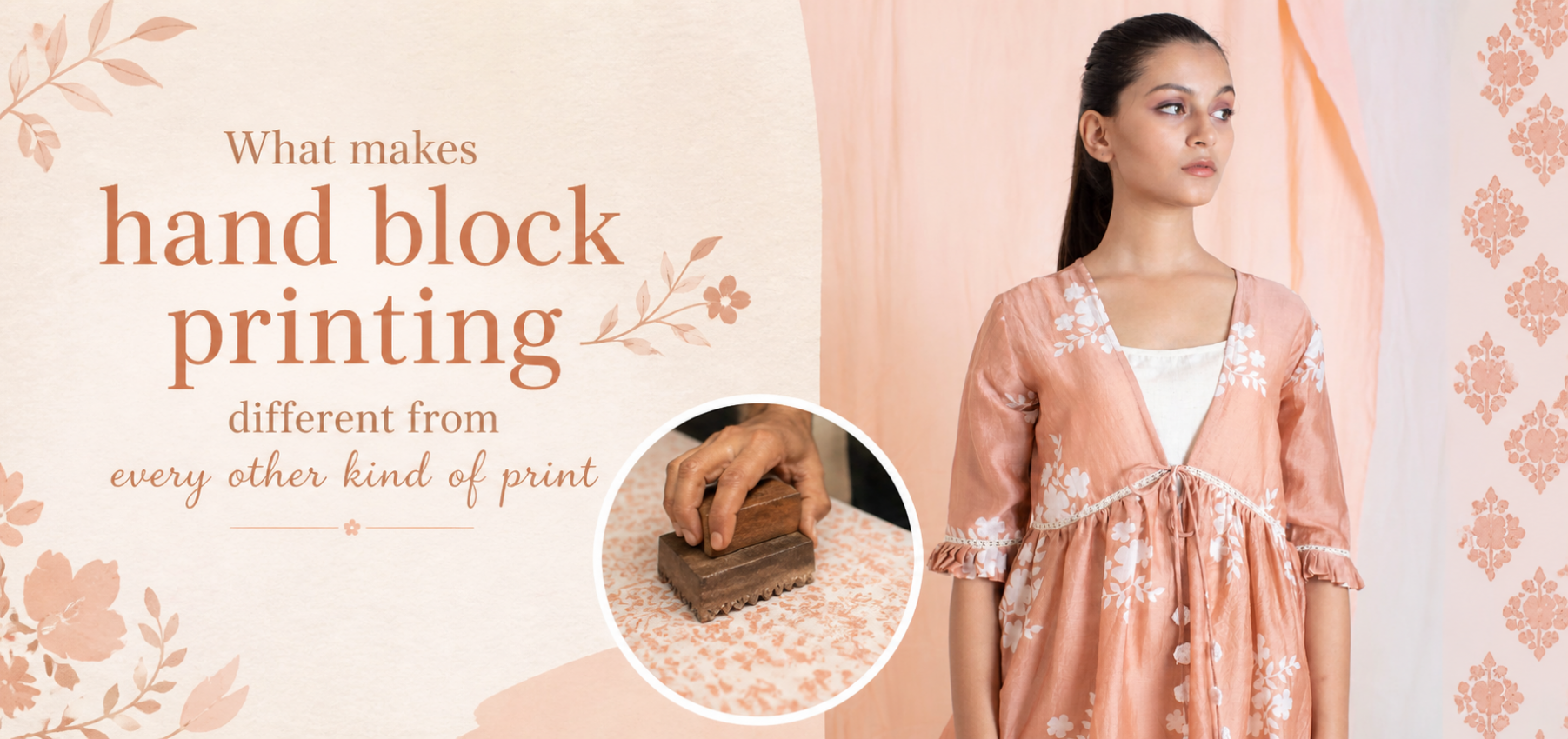
What makes hand block printing different from every other kind of print
The Art of Hand Block Printing: Where Imperfection Becomes Identity
In a world where a machine can print a thousand identical metres of fabric in under an hour, there exists a craft that has never surrendered to that efficiency — and has no intention of doing so. Hand block printing is, quite simply, a different category of making. Not a technique that competes with digital or screen printing, but one that operates on an entirely different philosophy: the philosophy that human hands, carved wood, and natural colour together create something a machine never can.
If you have ever held a hand block printed dress or kurta and noticed that something about it feels more alive than your other clothes — this piece is for you. We are going to go deep into what actually happens during the hand block printing process, why those small variations in pattern are intentional marks of authenticity rather than errors, and what separates this centuries-old Indian craft from every other form of fabric printing that exists today.
Why Every Piece Is Truly One of a Kind
Every hand block printed piece is, in the truest sense, a one-of-a-kind object. No two impressions are ever identical. That is not a flaw — it is the entire point.
A Craft That Is Older Than Most Nations
Before we can understand what makes hand block printing different, it helps to understand where it comes from. Evidence of block printing on textiles in India dates back over twelve centuries, with the craft flourishing significantly under Mughal patronage between the 16th and 18th centuries. The artisan communities of Rajasthan — particularly in Jaipur, Sanganer, and Bagru — built entire cultural identities around their block printing traditions, developing distinctive motif vocabularies, dye recipes, and printing rhythms that were passed from generation to generation within families.
This is not a technique that was invented in a factory or optimised by an algorithm. It was developed slowly, over centuries, through patient observation of how dye behaves on cotton, how wooden blocks wear over time, how the angle of a press affects the depth of colour. Every practice in the hand block printing process carries the weight of that accumulated knowledge.
The Hand Block Printing Process, Step by Step
Understanding the process is the fastest way to understand why the result is so different from anything a machine produces. There is no shortcut in this craft — each stage demands skill, attention, and time.
1. Block Carving
Artisans — often trained over years — hand-carve intricate motifs into dense wooden blocks, traditionally made from teak or sheesham. Each block represents a single colour or element of the final design. A multi-colour design can require ten or more separate blocks.
2. Fabric Preparation
The fabric — most often fine cotton — is pre-washed and treated with a mordant solution (typically a mix of myrobalan and water) that allows the dye to bond permanently. The cloth is then spread tightly on a long padded printing table.
3. Dye Preparation
Colours are mixed — either from natural sources like indigo, pomegranate rind, and turmeric, or from carefully chosen reactive dyes — and spread onto a dye tray or pad to ensure even coating of the block with each press.
4. The Printing
The artisan picks up the wooden block, presses it firmly and evenly into the dye, then stamps it onto the fabric in a rhythmic, measured sequence. Alignment is done entirely by eye and hand — there are no machines guiding placement. The block is re-dyed after every press.
5. Colour Layering
If the design has multiple colours, the process is repeated layer by layer — each colour allowed to dry before the next block is applied. This requires exceptional spatial memory and precision to ensure the motifs align correctly across the fabric length.
6. Washing & Sun-Drying
Once printing is complete, the fabric is washed to remove excess dye and mordant, then dried in the open air and sunlight — which helps fix the colour naturally and gives hand block printed textiles their characteristic gentle luminosity.
The Human Element Behind Every Print
What is striking about this process is the number of decisions a human being makes at every single stage. The pressure applied to the block, the angle of the stamp, the amount of dye taken with each press, the spacing between repeats — all of these are judgment calls made by a skilled artisan, not programmed parameters. That is why no two lengths of hand block printed fabric are ever truly the same.
How It Compares to Other Printing Techniques
To appreciate what is distinctive about hand block printing, it helps to look at it alongside the other printing methods that dominate modern textile production. Feature | Hand Block Printing | Digital Printing | Screen Printing | Rotary Printing |
Human craftsmanship | 100% handmade | Machine-operated | Partial | Fully automated |
Each piece unique | Yes — natural variation | Identical repeats | Identical repeats | Identical repeats |
Dye penetration | Deep, through fabric | Surface-level | Surface-level | Surface-level |
Colour longevity | Excellent (with care) | Fades faster | Good | Good |
Sustainability potential | High (natural dyes possible) | Moderate | Moderate | Lower |
Artisan livelihood support | Direct & significant | Minimal | Minimal | None |
Production speed | Slow (intentionally) | Very fast | Fast | Very fast |
Cultural heritage value | Centuries-deep | None | None | None |
The table above tells a clear story. In almost every dimension that matters beyond raw speed and volume, hand block printing offers something that mechanical methods simply cannot replicate. And increasingly, discerning customers — particularly in India's growing craft-conscious fashion market — are choosing to prioritise those dimensions.
The Regional Voices of Indian Block Printing
One of the most fascinating aspects of this craft is that it is not monolithic. Different regions of India have developed distinct traditions within the broader umbrella of hand block printing, each with its own design language, dye palette, and technical approach.
Sanganer, Rajasthan
Style: Floral & Geometric
Known for delicate floral repeats on white or off-white backgrounds, typically using black and red. Sanganer printing is refined and intricate, often associated with fine cotton dupattas and dress fabrics.
Bagru, Rajasthan
Style: Dabu Resist Printing
Famous for its mud-resist technique (dabu), which uses a paste of black clay and gum to block dye from reaching certain areas of the fabric, creating distinctive white-on-dark or light-on-dark patterns.
Jaipur, Rajasthan
Style: Multi-colour, Bold
Jaipur block printing tends toward richer colour combinations and bolder scale motifs. The city's craft tradition spans both traditional and contemporary design vocabulary, making it a hub for fashion-forward block prints.
Pethapur, Gujarat
Style: Block Carving Heritage
While Pethapur is better known for producing the carved wooden blocks themselves, its artisans are among India's finest block makers, supplying craftspeople across the country with their essential tools of trade.
Why the "Imperfections" Are Actually the Point
When people encounter hand block printed fabric for the first time, they sometimes notice slight variations in colour depth, tiny misalignments between repeat motifs, or areas where the dye has pooled slightly at the edge of a print. In machine printing, these would be quality defects to be eliminated. In hand block printing, they are signatures of authenticity.
Every slight variation you see is a record of a real moment — an artisan pressing a wooden block to fabric, at a particular angle, with a particular amount of dye, under the light of a particular day. These variations mean that no two pieces are truly identical, even when they come from the same block run. This is what transforms a piece of clothing from a product into something closer to an object of craft — and it is why collectors and conscious fashion lovers value hand block printed textiles so deeply.
The Artisan Behind Every Print
In Rajasthan's printing communities, many artisans have been practising this craft for over three decades, having learned from their parents or grandparents. When you wear a hand block printed piece, you are wearing the work of someone whose entire professional life has been devoted to mastering this one skill.
The rhythm of block printing — press, lift, re-dye, align, press — is something that takes years to internalise. Experienced printers develop an almost musical sense of timing, producing patterns with a consistency that feels impossible given that no machine is guiding them.
Wearing a Hand Block Print — What to Look For
If you are building or refreshing your wardrobe with hand block printed pieces, knowing how to identify genuine craftsmanship helps you shop more intentionally. Here is what to look for:
Signs of Authentic Hand Block Printing
Turn the garment over and examine the reverse side — in genuine hand block printing, the colour partially penetrates through the fabric, so the back will show a softer version of the print. Machine prints typically remain entirely on the surface. You should also be able to see slight natural variations in colour intensity across the repeat — deeper where the artisan pressed harder, lighter where the block met fabric at a slight angle.
Look also at how the pattern meets the seams. In a well-made hand block printed garment, the printer has accounted for the cut — a level of intentionality that machines do not exercise. And if you are considering a block print dress, hold it up to natural light. Genuine hand block printed cotton has a gentle luminosity that synthetic-print fabrics simply do not carry.
Fabric Choice Matters
Hand block printing works best — and is most traditionally practised — on natural fabrics: fine cotton, cotton-silk blends, and Chanderi. These fabrics accept dye in a way that synthetic fibres do not, allowing colours to bond deeply with the textile structure rather than sitting only on the surface. This is why Chanderi tops in hand block print carry such a distinctive luminosity: the fabric's natural silk content reflects light through the printed layer in a way that feels genuinely different from anything polyester can offer.
Hand Block Printing and the Slow Fashion Movement in India
There is a reason hand block printing has become so closely associated with the slow fashion conversation in India. The craft is, by its very nature, a rejection of the logic of fast fashion. It cannot be scaled arbitrarily — a skilled printer can produce only a limited length of fabric per day, and the process cannot be rushed without compromising quality. This inbuilt limit is a feature, not a flaw.
For the growing number of Indian women who are shopping more thoughtfully — choosing fewer, better pieces rather than volumes of disposable fashion — hand block printed clothing offers a compelling answer. Whether it is a beautifully draped tunic set for women in a Jaipur floral block, a flowing everyday dress in indigo-dyed cotton, or a layered occasion piece in Chanderi — the investment in craftsmanship is visible, wearable, and lasting.
In cooler months, a golden shrug for women in a block-printed Chanderi or cotton-silk becomes something genuinely different from a machine-made jacket: a piece of wearable craft that ages gracefully and tells a story each time it is worn.
Caring for Your Hand Block Printed Pieces
Hand block printed garments reward attentive care. A few simple practices will preserve both the colour and the fabric integrity for years.
Wash in cold water with a mild, pH-neutral detergent — ideally by hand or on a gentle machine cycle. Avoid soaking for extended periods, and never wring the fabric harshly. Dry in the shade rather than direct sunlight, which can fade natural and reactive dyes over time. Iron on a medium heat setting, ideally on the reverse side, to protect the printed surface. Avoid bleach or harsh chemical detergents entirely.
Well-maintained women cotton dresses in hand block print can remain vibrant and structurally sound for years, often becoming more characterful with gentle age — softer to the touch, the colours settling into a warm, lived-in depth that newly-printed fabric simply does not have. In this sense, caring for a hand block printed piece is genuinely different from caring for a fast-fashion garment: it is maintenance of something worth maintaining.
What Makes This Craft Irreplaceable
There is a certain question that comes up whenever traditional crafts are discussed in the context of modern fashion: given that machines can now produce increasingly convincing simulations of handcraft, will the real thing eventually become unnecessary?
The answer, for hand block printing, is no — and the reason is precisely the one that digital optimisation cannot touch. The value of hand block printing is not merely aesthetic. It is the value of knowing that a human being made this, that the process was slow and considered, that the craft carries centuries of cultural knowledge, and that purchasing it supports the continuation of a living tradition and the livelihoods of the artisans who carry it.
When you wear a hand block printed piece, you are wearing evidence of human skill, cultural memory, and conscious making. A machine-printed fabric — however sophisticated the algorithm that generated its design — carries none of that weight. That is what makes hand block printing different from every other kind of print: not just what it looks like, but what it is and what it means.
For women exploring women slip dresses or relaxed everyday styles, choosing hand block printed cotton is also a statement: a choice to dress in something that was made with care, by someone who has dedicated their working life to a craft that cannot be automated away.
Frequently Asked Questions
What is the hand block printing process and how does it actually work?
The hand block printing process involves artisans hand-carving intricate motifs into dense wooden blocks — typically teak or sheesham — then dipping these blocks into natural or reactive dyes and pressing them rhythmically onto pre-treated fabric. Each colour in a design requires a separate carved block. The entire process is manual: no machine guides the alignment or pressure, which is why each piece carries subtle natural variations that make it genuinely unique.
How is hand block printing different from digital fabric printing?
Digital printing uses inkjet technology to reproduce a computer-generated pattern on fabric with pixel-perfect, identical consistency. Hand block printing is entirely manual — the pressure, angle, and dye absorption all vary slightly with each press. This creates natural, subtle irregularities that make every hand block printed piece different from every other, something a digital printer cannot replicate. The dye also penetrates more deeply into the fabric structure, resulting in richer colour longevity.
Which cities in India are most famous for hand block printing?
Jaipur and Sanganer in Rajasthan are the most celebrated centres, known for floral and geometric motifs on fine cotton. Bagru (also Rajasthan) specialises in dabu mud-resist printing, which creates distinctive light-on-dark patterns. Pethapur in Gujarat is famous for producing the carved wooden printing blocks themselves. Each region has developed its own design vocabulary, motif library, and dyeing traditions over centuries.
How should I care for hand block printed clothing to preserve its colour?
Wash hand block printed garments in cold water with a mild, pH-neutral detergent — by hand or on a gentle machine cycle. Avoid extended soaking and harsh wringing. Dry in the shade rather than direct sunlight to protect colour vibrancy. Iron on the reverse side on a medium setting. Keep bleach and strong chemical detergents away entirely. With proper care, a hand block printed cotton piece can remain vibrant for years, often becoming more characterful and soft with gentle age.
Is hand block printed fabric sustainable and eco-friendly?
Hand block printing is among the most sustainable textile crafts available. Traditional block printing uses natural dyes from plants, minerals, and roots, with a significantly lower environmental footprint than synthetic chemical dyes. The process is entirely human-powered — no machine emissions are involved. It also directly supports the livelihoods of skilled artisan communities in Rajasthan and Gujarat, making it a socially responsible fashion choice alongside its environmental benefits.
-
 August 26th, 2026
 -
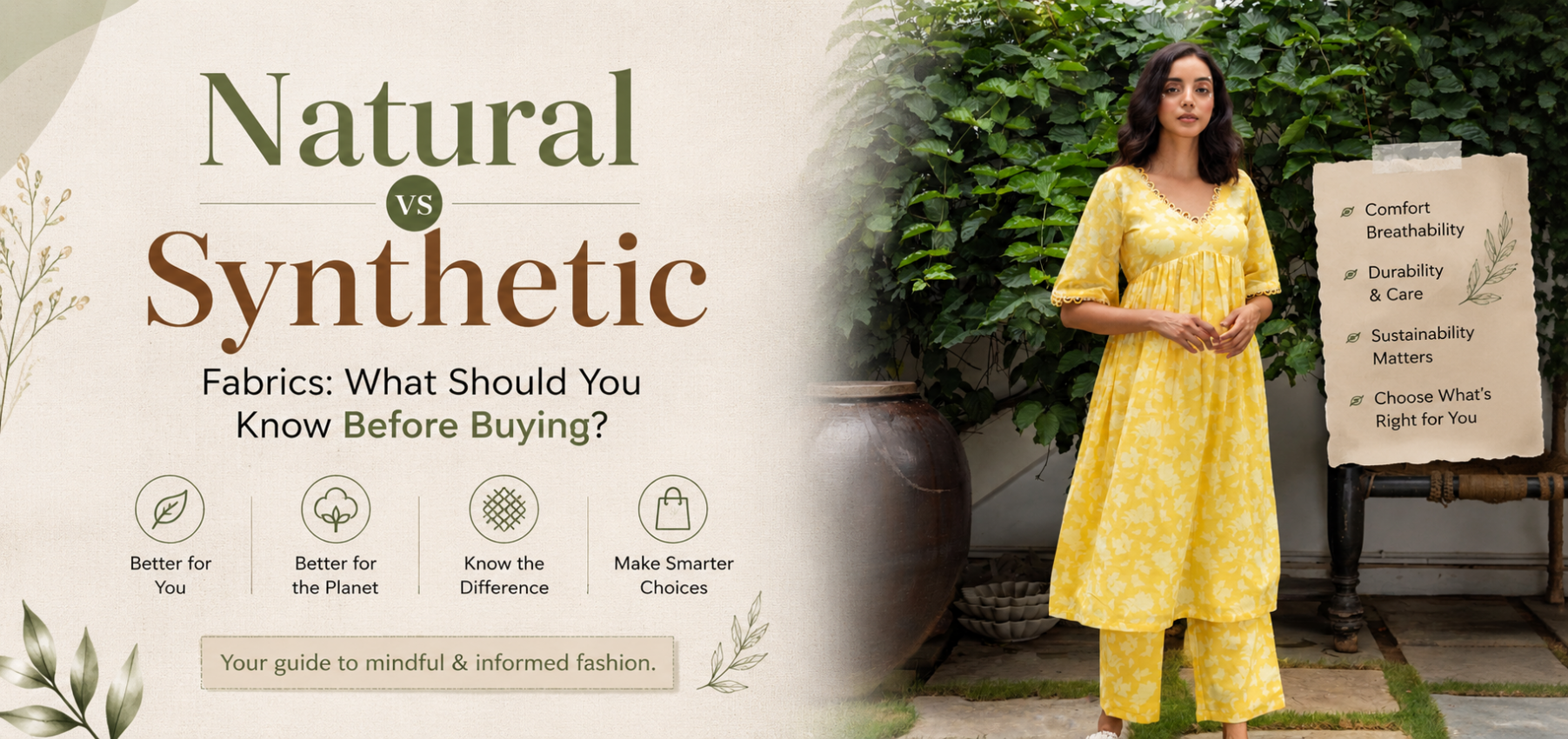
Natural vs Synthetic Fabrics: What Should You Know Before Buying?
August 24th, 2026 -
 August 24th, 2026
 -
 August 13th, 2026