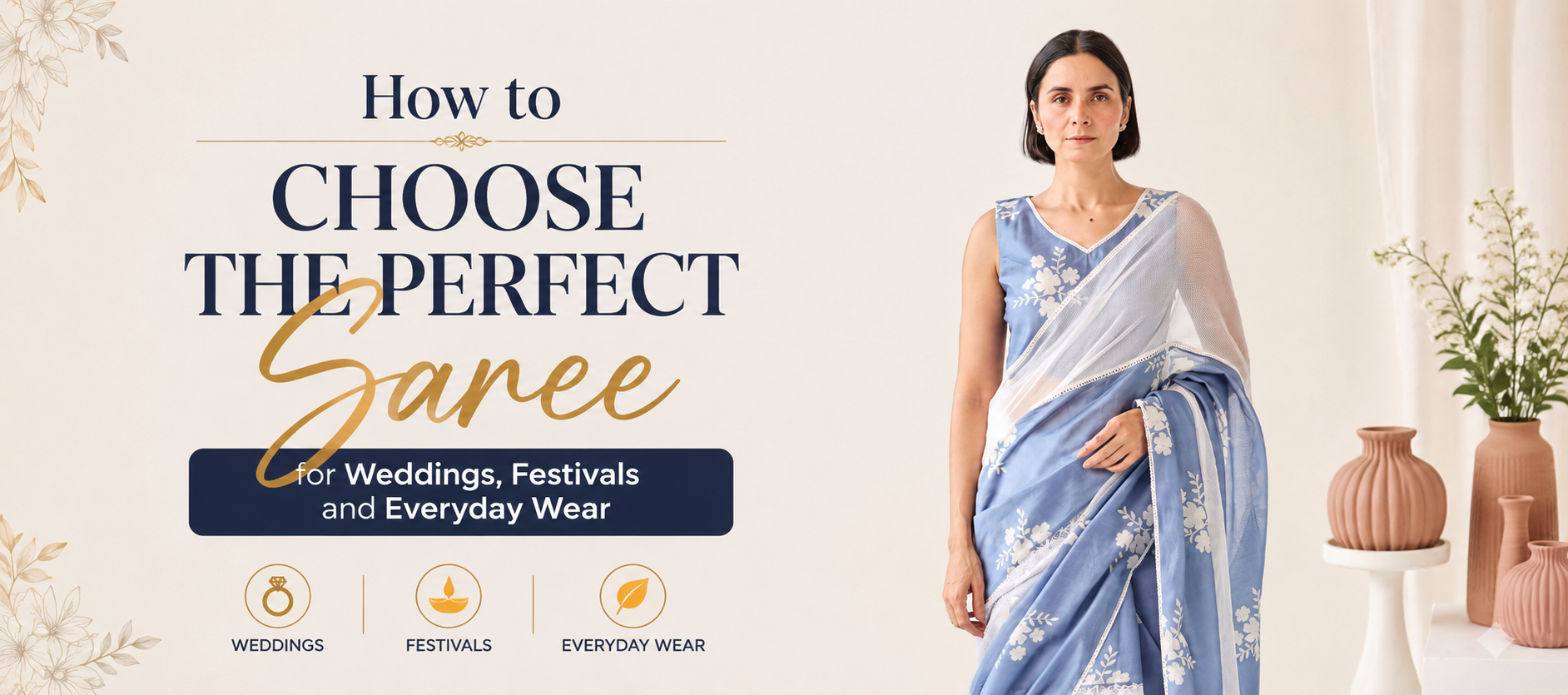
How to Choose the Perfect Saree for Weddings, Festivals and Everyday Wear
A saree is not just a garment — it is a conversation between tradition and the woman who wears it. Whether you are dressing for a bride's mehendi, a Diwali puja, or a routine Tuesday at work, the right saree can be transformative. Yet, with hundreds of weaves, fabrics, and regional traditions to navigate, choosing one can feel overwhelming.
This guide cuts through the clutter. Drawing on India's rich textile heritage — and the quiet wisdom of women who drape sarees daily — it will help you match the perfect saree to the occasion, your body, the season, and your personal comfort level. No jargon. No unnecessary complexity. Just clear, honest guidance.
Why the Occasion Should Always Come First
Before you think about colour or pattern, ask yourself one question: Where am I going, and what will I be doing there? The most common saree-buying mistake is falling in love with a fabric that is wrong for the context — a heavily embroidered silk at an afternoon garden wedding, or a sheer georgette at a formal office event.
Indian occasions broadly fall into three categories, and each has its own saree logic:
Occasion Type | Best Fabric | Key Consideration |
Weddings (guest / family) | Banarasi, Kanjivaram, Chanderi, raw silk | Richness of weave, jewel tones, zari border |
Festivals & pujas | Cotton, Chanderi, linen, tussar | Comfort for long hours, traditional motifs |
Office & daily wear | Cotton, linen, soft Chanderi, georgette | Breathability, easy drape, modest prints |
Once you match the occasion, every other decision — weight, print, colour, blouse — becomes much easier.
Understanding Saree Fabrics: What Works for Indian Climate and Lifestyle
India's climate is diverse and so are its saree traditions. A fabric that feels luxurious in a Shimla winter can feel suffocating at a Mumbai wedding in May. Here is a clear breakdown of the most widely worn fabrics:
Chanderi: Woven in Madhya Pradesh with silk and cotton, Chanderi is featherlight with a soft luminosity. Ideal for both festive wear and cooler office days.
Cotton: The go-to fabric for everyday India. Breathable, washable, and available in rich block-printed and plain weave options. Perfect for summer and daily routines.Banarasi / Kanjivaram Silk: The prestige fabrics of Indian weddings. Heavy, lustrous, and intricately woven — best reserved for formal ceremonies where movement is limited.
Tussar Silk: Textured with a matte finish — tussar strikes a middle ground between heavy silk and daily cotton. Excellent for festive occasions in transitional seasons.
Georgette & Chiffon: Fluid and light, these fabrics are flattering on most body types. Easy to drape but require petticoat weight for structure.
Linen: A rising favourite for working women — structured, crisp, and extremely breathable. Pairs beautifully with block-printed or hand-painted motifs.
Insider tip: If you want one fabric that transitions gracefully from a festive afternoon to a cultural event in the evening, a Chanderi saree is arguably the most versatile choice in the Indian wardrobe. Its natural sheen reads as celebratory, yet its weight means you can wear it for hours without fatigue.
Choosing a Saree for a Wedding — As a Guest or Family Member
Indian weddings are multi-day affairs with shifting dress codes — mehendi is colourful and playful, haldi is typically earthy or yellow, sangeet calls for something glamorous, and the main wedding day is where the grandest drapes come out. A single saree cannot cover all of these, so plan thoughtfully.
Colour Protocol Worth Knowing
Traditionally, white and red are reserved for the bride across many Indian communities. Beyond that, there are no strict rules — but deeply saturated jewel tones (emerald, cobalt, magenta, plum) photograph beautifully and hold their visual presence in a crowd. Pastels and ombre prints work well for daytime events where bright sunlight is your lighting.
When Zari and Embroidery Make Sense
Zari borders and embroidered pallus add gravitas to a saree. At formal ceremonies — particularly in North Indian and South Indian wedding traditions — they signal that you have dressed with intention. However, if the venue is outdoors or involves dancing, heavily embellished sarees can become cumbersome. A richly woven but lightweight option, such as a handloom Chanderi saree with a zari border, gives you formality without discomfort.
What to Wear as a Bride's Family vs a Guest
Family members of the bride or groom are expected to dress in coordinated colours in many traditions. Guests have more flexibility, but the golden rule holds: be elegant, not louder than the couple. A well-chosen, thoughtfully draped saree always reads as more stylish than an overdressed one.
Sarees for Festivals — Where Tradition Meets Personal Expression
Diwali, Navratri, Onam, Durga Puja, Pongal — Indian festivals are as much about dressing as they are about ritual. The defining characteristic of a festival saree is that it should feel celebratory without being impractical. You may be standing for puja, sitting cross-legged on the floor, or dancing in a circle — none of which are comfortable in a heavy Kanjivaram.
Cotton and Chanderi sarees genuinely excel here. They move well, they do not trap heat, and their natural fibres feel appropriate for the spiritual context of most Indian festivals. Hand block-printed patterns — florals, paisleys, geometric motifs — add a visual richness that is distinctly festive without being ostentatious.
Colour Symbolism in Festival Dressing
Many Indian festivals carry colour traditions: yellow for Basant Panchami, red and green for Teej, white for certain South Indian festivals. While these are not obligatory for most occasions, wearing culturally resonant colours adds an intentional layer of meaning to your outfit that people notice and appreciate.
The Yellow Bow approach to festival dressing:Our Chanderi sarees are designed with precisely this balance in mind — hand block-printed patterns that feel festive, weights that are comfortable for long hours, and colours chosen to honour Indian textile traditions while appealing to a contemporary palette. You can explore our range of printed chanderi sarees and find your next festival favourite.
The Everyday Saree — Making It Work for Office, Travel and Daily Life
There is a growing and well-deserved enthusiasm across India for the everyday saree — worn not just on special occasions, but as a practical, comfortable daily garment. For this to work, fabric choice and draping style are everything.
Which Fabrics Survive the Daily Grind
Cotton is the undisputed champion of everyday wear. It is machine-washable (or easy to hand-wash), gets softer with each wash, and maintains its shape. Linen offers a slightly more structured alternative with excellent breathability. Both look equally good with a simple tucked blouse or a short-sleeved fitted top, which is a popular styling choice among younger professionals.
If you are building a daily wear saree wardrobe, consider pairing your sarees with women cotton dresses or casual blouses that allow quick changes — this extends the versatility of each piece you own.
The Nivi Drape and Its Variations
The Nivi drape (the most widely used style across India, with pleats tucked at the front and the pallu over the left shoulder) is a safe and elegant default. For those who want more freedom of movement — particularly commuters and working professionals — the Gujarati drape or the seedha pallu variation offer practical alternatives where the pallu is pinned at the shoulder and does not swing loose during movement.
Pre-stitched and semi-stitched sarees are worth considering if you are new to draping or simply short on time. They can be worn in under three minutes and look every bit as neat as a traditionally draped saree — a practical option for office mornings.
Body Type, Height and the Saree — Practical Guidance
Every body type looks beautiful in a saree — the garment's design is genuinely democratic. That said, a few fabric and draping choices can help you feel more comfortable and confident:
For Petite Frames
Lightweight fabrics like Chanderi and georgette create vertical movement and volume without overwhelming a smaller frame. Avoid very broad horizontal borders, which can visually shorten the silhouette. A fine zari or printed border works better. High-heeled footwear — a simple pair of embellished juttis or block heels — adds the height that a petite frame benefits from.
For Taller Frames
Taller women can carry heavier fabrics like silk and tussar with ease. Wide borders, bold prints, and large pallus all look striking on a taller silhouette. Deep, jewel-toned sarees with thick zari borders are especially flattering.
For Fuller Figures
Structured fabrics like cotton and linen drape cleanly and avoid the clinginess of lighter synthetics. Darker colours and vertical prints are classic choices, but this is largely a matter of personal preference rather than obligation. A well-tied saree in the right fabric looks elegant on every body.
Handloom vs Machine-Made: Understanding What You Are Buying
As you shop — whether in person or when you browse chanderi sarees online — you will encounter both handloom and machine-made options. Understanding the difference helps you make informed decisions and support the artisans behind India's textile heritage.
What Makes a Saree Truly Handloom
A chanderi handloom saree is woven thread by thread on a pit loom or frame loom by a skilled weaver. The process is slow — a single saree can take anywhere from two days to two weeks — and the result carries natural irregularities: slight variations in weave density, a texture that machine looms cannot replicate. These imperfections are not flaws; they are proof of human craft.
Machine-made sarees are consistent, affordable, and widely available. They are a legitimate choice for daily wear. But if you are looking for something that will last for decades, grow more beautiful with age, and carry genuine cultural meaning, a handloom piece is the wiser investment.
How to identify genuine handloom: Look for a Handloom Mark certification tag, slight variations in the weave, and a texture that feels distinctly different from machine-made fabric. Reputable brands, including those certified through the Handloom Mark scheme, will disclose this information clearly.
Blouse, Petticoat and Accessories — The Details That Complete the Look
The saree itself is only part of the picture. A perfectly chosen saree can be underwhelming if the blouse, petticoat, and accessories are afterthoughts.
Blouse Choices That Elevate the Saree
The blouse is the most visible element of a saree ensemble after the pallu. A contrast blouse — say, a deep teal blouse with a cream Chanderi saree — adds visual interest and personality. Sleeve length and neckline should be chosen with the occasion in mind: a halter-neck blouse for a festive party, a modest round neck for office or religious events. At The Yellow Bow, our handcrafted blouses are specifically designed to complement our saree collection.
The Petticoat and Why It Matters
The petticoat provides the base structure for your drape. Its colour should ideally match or closely complement the saree — a bright white petticoat under a sheer fabric will show. For lightweight sarees, choose a petticoat in a slightly heavier cotton for added structure and coverage.
Jewellery: Less Is Often More
Heavy sarees like Banarasi silk carry their own visual weight — minimal jewellery (a pair of jhumkas and a maang tikka) is often more elegant than layering multiple necklaces. Lighter sarees like Chanderi and cotton welcome more jewellery — long neckpieces, stacked bangles, and statement earrings all work beautifully.
Caring for Your Saree — Making It Last for Generations
A well-made saree, properly cared for, can outlast the fashion cycles that claim most fast-fashion garments. Here are the essential care principles:
Washing: Silk and handloom sarees should always be dry-cleaned or hand-washed in cold water using a mild, pH-neutral detergent. Never machine wash. Cotton sarees can be hand or machine washed on a gentle cycle in cold water.
Drying: Always dry flat or on a wide hanger — never wring a silk or Chanderi saree. Keep out of direct sunlight, which fades colours and weakens fibres over time.
Storage: Fold sarees along different crease lines each time to prevent permanent fold marks. Store in muslin or cotton cloth, never plastic. Add dried neem leaves or anti-moth sachets to your storage space.
Ironing: Use a low-to-medium setting for cotton and linen. For silk and Chanderi, iron on the reverse side with a thin cotton cloth between the iron and the saree. Never iron directly over printed or embellished areas.
Finding Your Perfect Saree — A Closing Thought
The idea of a perfect saree is ultimately personal — it is the one that makes you feel most like yourself, whether that is a crisp handloom cotton on a weekday morning or a luminous Chanderi at a Diwali dinner. The guidance above is a framework, not a formula.
India's saree traditions are vast, regional, and alive. Each weave tells the story of the place it comes from — Chanderi from Madhya Pradesh, Banarasi from Varanasi, Kanjivaram from Tamil Nadu. When you wear a handloom saree, you are not just wearing fabric. You are wearing someone's skill, their time, and the cultural memory of an entire community of weavers.
Dress with that awareness, and every saree you own will feel exactly right.
Frequently Asked Questions
Which saree fabric is best for Indian summers?
For Indian summers, lightweight breathable fabrics like Chanderi, cotton, linen, and georgette are the most practical choices. A handloom Chanderi saree, in particular, offers a distinctive advantage — it is woven from a silk-cotton blend that is featherlight, allows airflow, and yet carries a subtle sheen that makes it look appropriately festive even in intense heat.
What type of saree should a wedding guest wear?
As a wedding guest, a rich silk, raw silk, or a finely woven Chanderi saree in jewel tones or pastels is always appropriate. Avoid white and red, which are traditionally associated with the bride in many Indian communities. For daytime outdoor weddings, choose lighter fabrics; for evening receptions, you can opt for more heavily embellished or silk-based options.
How do I choose a saree for the office?
Office sarees should prioritise comfort and a neat drape that stays in place through a full workday. Cotton, linen, and soft Chanderi sarees in subtle prints or solid colours are the most practical. Pair with a well-fitted blouse and a secure drape — the Nivi style with the pallu pinned at the shoulder works particularly well for professional settings.
What is the difference between a handloom and machine-made Chanderi saree?
A handloom Chanderi saree is woven entirely by hand on a traditional loom by skilled weavers in Chanderi, Madhya Pradesh. It carries natural slight variations in texture and weave that are the mark of genuine craftsmanship. Machine-made versions are consistent and more affordable, but lack the depth of texture, the subtle luminosity, and the cultural story that a genuine handloom piece carries. For longevity and authenticity, handloom is always the better investment.
How should I store and care for a silk or handloom saree?
Silk and handloom sarees should be dry-cleaned or gently hand-washed in cold water with a mild detergent. Never wring or machine wash. Store them folded in muslin cloth — not plastic — in a cool, dry space away from direct sunlight. Refold along different crease lines every few months to prevent permanent creases. Iron only on the reverse side at low heat, with a cotton cloth as a buffer to protect the fabric and print.
-
 August 26th, 2026
 -
Natural vs Synthetic Fabrics: What Should You Know Before Buying?
August 24th, 2026 -
 August 24th, 2026
 -
 August 13th, 2026