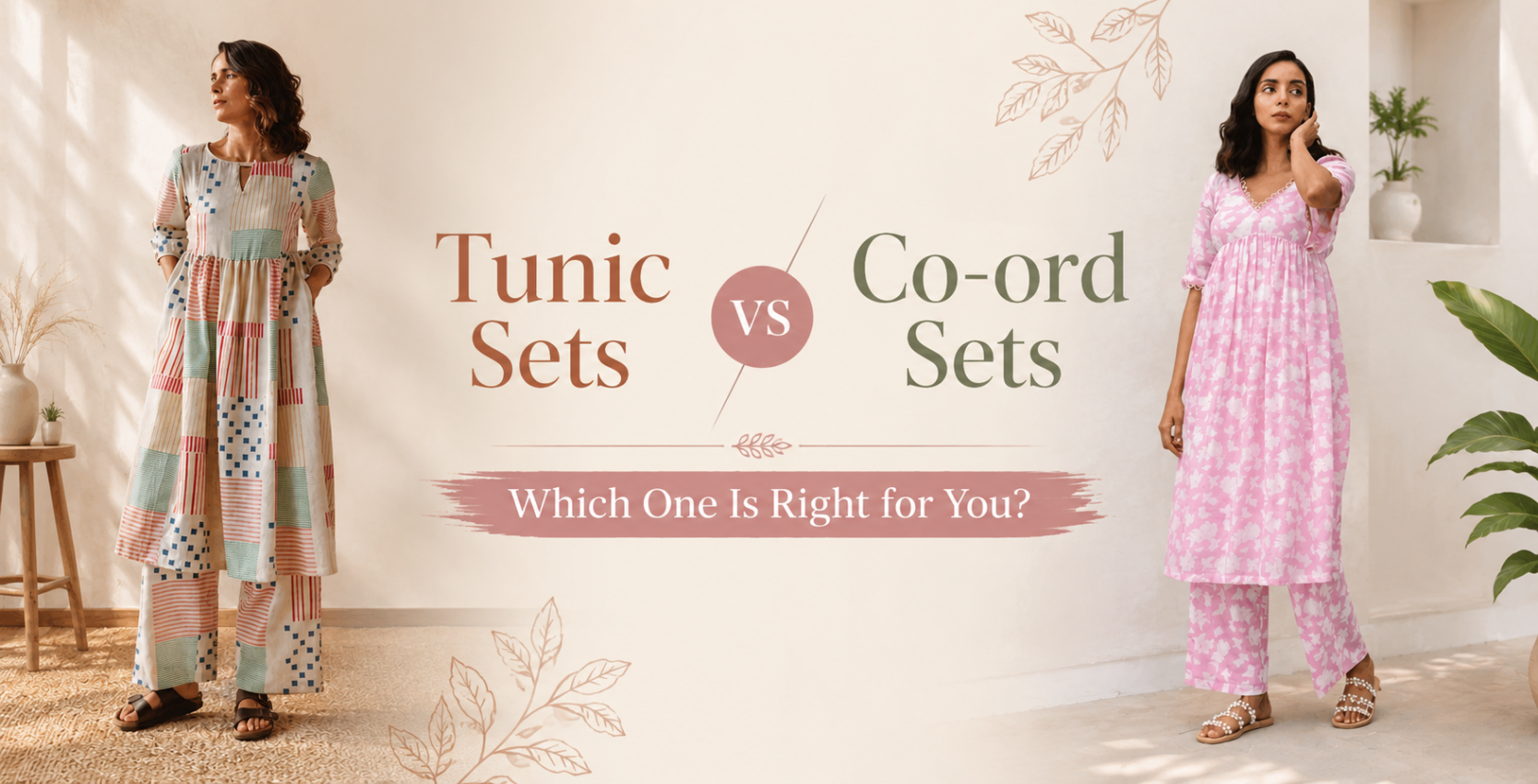
Tunic Sets vs Co-ord Sets — Which One Is Right for You?
Every woman has stood in front of her wardrobe at some point and thought: Should I go ethnic or keep it modern today? The good news is that in 2026, you don't have to pick a side — because both tunic sets and co-ord sets let you walk out looking effortlessly put-together without spending an hour mixing and matching.
But here's the real question: when you're browsing online or walking into a store, how do you know which silhouette actually works for your lifestyle, your body, your occasion, and your comfort level?
This guide breaks it all down — honestly and practically — so you can shop smarter and dress better.
“The right outfit isn't about trends. It's about wearing something that feels like yours — and still turns heads.”
Understanding the Basics: What Are These Styles, Really?
Tunic Sets — Structure with Ease
A tunic set is a coordinated outfit built around a longer, flowy top — typically falling anywhere between the hip and the knee — paired with matching or contrast bottoms such as palazzos, straight-cut pants, churidars, or wide-leg trousers.
The tunic (or kurti-style top) has roots in South Asian dressing traditions, but modern tunic sets for women have evolved significantly. Today's versions incorporate block prints, pintucks, hand embroidery, and structured necklines that feel contemporary without losing their cultural warmth.
The beauty of a tunic set lies in its wearability. It's forgiving on different body types, incredibly comfortable for all-day wear, and transitions effortlessly from a morning commute to an evening family gathering.
Co-ord Sets — Modern Matching Made Easy
A co-ord set — short for coordinated set — is a matching two-piece outfit where the top and bottom are cut from the same fabric, print, or color palette. Think: a printed crop top with wide-leg pants in the exact same fabric. Or a straight shirt with a matching skirt.
Co-ord sets can be styled for both ethnic and Western occasions, depending on the fabric and silhouette. In the Indian context, women cotton dresses and co-ord sets in handloom cotton or block-printed cotton have become extremely popular for their breathability and artisanal character.
The appeal of a co-ord set is that the hard work is done for you. You look polished without having to think. The two pieces are designed to work together — in colour, in print, in proportion — giving you a curated, fashion-forward look with minimal effort.
Tunic Sets vs Co-ord Sets: A Side-by-Side Comparison
Here's a quick, honest overview of how these two styles compare across the most important factors:
Factor | Tunic Set | Co-ord Set |
Silhouette | Longer top, ethnic/relaxed structure | Matching pieces, contemporary proportions |
Coverage | More coverage, hip-to-knee length | Variable — depends on the cut |
Occasions | Office, casual, family functions, travel | Brunches, travel, festive, semi-formal |
Body Adaptability | Very forgiving — suits most body types | Best when proportions are considered |
Mix & Match | Top and bottom can be styled separately | Usually worn as a complete unit |
Comfort Level | High — especially in cotton/mulmul | High — breathable if cotton/linen |
Fabric Typically Used | Cotton, mulmul, chanderi, linen | Cotton, handloom, georgette, rayon |
Styling Effort | Moderate — accessories make a difference | Low — looks complete on its own |
Price Point | Moderate to premium (craft quality) | Moderate to premium (fabric-dependent) |
How Does Each Style Actually Feel to Wear?
Practicality matters as much as aesthetics, especially for Indian women who wear their clothes through long, active days — commuting, desk work, home responsibilities, and social occasions — sometimes all on the same day.
Wearing a Tunic Set Through Your Day
Imagine waking up, slipping into a hand block printed cotton tunic with straight-cut pants, and not having to think again about what you're wearing until you change for bed. That's the tunic set experience.
The longer top length gives you freedom of movement without constantly worrying about tucking or adjusting. The wide necklines, comfortable cuts, and breathable fabrics mean that even after a long day, you still feel fresh. For women who are on their feet a lot, travel frequently, or work in environments that require a balance between formal and comfortable, tunic sets are genuinely hard to beat.
Another underrated advantage: the top of a tunic set can often be worn separately with jeans, palazzos, or even over leggings — giving your wardrobe more versatility than it appears.
Wearing a Co-ord Set: Effortless Confidence
Co-ord sets have a different kind of appeal. There's something inherently confident about wearing two perfectly matched pieces. When you're wearing a co-ord, you look like you planned it — even if you picked it up in five minutes.
The matching print or colour creates a visual continuity that makes you appear taller, leaner, and more intentional in your dressing. For women who love fashion but don't always have time to curate outfits, this is a genuine lifestyle solution.
For Indian summers specifically, women cotton co ord sets in breathable fabrics like mulmul or soft cotton are a revelation — you stay comfortable and look dressed up without layering or over-styling.
Choosing Based on Body Type and Fit
One of the most common questions women ask when shopping for coordinated outfits is: "Which silhouette will actually look good on me?" The honest answer is that both can work beautifully — it's more about cut and fabric than category.
For Petite Frames
- Co-ord sets in vertical prints create length
- Shorter tunics (hip-length) avoid swamping the frame
- Monochromatic co-ords elongate the silhouette
- Avoid oversized, boxy tunic tops
For Curvy & Plus Frames
- A-line and flared tunic sets are supremely flattering
- Co-ords with wide-leg pants balance proportions
- Block prints draw the eye beautifully on both styles
- Avoid overly fitted co-ords in stiff fabrics
For Athletic & Tall Frames
- Co-ord sets with crop tops and wide pants look stunning
- Long tunics elongate further — use with confidence
- Horizontal prints and belted tunics add curves
- Experiment with oversized co-ord silhouettes
For Pear-Shaped Frames
- Longer tunic tops balance wider hips beautifully
- A-line kurtas paired with straight pants are ideal
- Co-ords with flowy palazzo bottoms work well
- V-necks and embellished necklines draw attention up
Style Tip: Regardless of body shape, always prioritise fabric quality. A well-cut tunic in good cotton will outperform an ill-fitting co-ord in any comparison. The fabric drape is what makes or breaks how a coordinated outfit looks on your body.
Occasion Guide: What Works Where?
One of the most practical ways to choose between the two styles is to think about where you're going and what the setting demands. Here's a breakdown across the most common Indian occasions:
Everyday Wear and Work
For the office or everyday errands, tunic sets in cotton or linen with structured bottoms are the go-to choice for most Indian women. They communicate a certain put-together-ness without feeling overdressed. Co-ord sets work equally well if the silhouette is appropriate — a tailored short-sleeved shirt with matching wide-leg trousers, for instance, is entirely office-appropriate.
Casual Outings and Brunches
This is where co-ord sets truly shine. A printed cotton co-ord with block print detailing, paired with strappy sandals and a jhumka, is a complete, stylish brunch look. Tunic sets also work here — especially relaxed fits with kantha prints or subtle embroidery — but co-ords tend to feel more occasion-specific.
Travel and Long Days Out
Both styles are excellent for travel, but tunic sets have a slight edge for very long journeys because of the extra length and coverage. The breathable cotton factor matters enormously here — lightweight block printed cotton is your best friend when you're in transit through Indian summers or monsoon humidity.
Festive and Family Occasions
Both styles can be dressed up for festive occasions depending on the fabric. A tunic set in chanderi or silk cotton with a block printed dupatta instantly reads festive. A co-ord set in a richer fabric — think deep colours, subtle zari work, or artisanal prints — can hold its own at a puja, a mehendi, or a casual festive gathering. For formal weddings, however, neither may be enough on its own — pairing with a jacket or shrug elevates both significantly.
The rule of thumb: If the occasion requires you to look polished but comfortable — reach for either. If it demands that you look effortlessly stylish with minimal thought — pick a co-ord. If you want to dress with cultural warmth and flexibility — choose a tunic set.
Fabric Is Everything — Especially in India's Climate
Indian weather is not kind to synthetic fabrics. Across most of the country, summers are brutal, humidity is unforgiving, and even mild winters call for breathable layering. This makes fabric choice arguably more important than silhouette when choosing between tunic sets and co-ord sets.
Cotton: The Undisputed Champion
Pure cotton — whether soft mulmul, handloom khadi cotton, or double-layered cotton — remains the best fabric for both tunic sets and co-ord sets in India. It breathes, absorbs moisture, stays soft through washes, and takes block print beautifully. When shopping for either style, 100% cotton should always be your first filter.
Handloom Fabrics: Heritage Meets Comfort
Handloom cotton and chanderi are increasingly popular for tunic sets in particular. The natural texture of handloom fabric adds visual interest without needing heavy embellishment. These fabrics are slightly more structured than soft cotton, making them excellent for slightly dressier occasions while remaining entirely breathable.
What to Avoid
Polyester blends, heavy synthetics, or stiff fabric co-ords may look good on a hanger but will make you deeply uncomfortable through a warm Indian day. For both styles, always prioritize natural fibres — and if in doubt, feel the fabric before you buy.
How to Style Each — Practical Tips That Actually Work
Styling a Tunic Set
The versatility of a tunic set comes to life when you accessorise thoughtfully. A few guiding principles:
- Add a dupatta or stole for festive occasions — instantly elevated
- For office wear, keep accessories minimal: stud earrings, simple flats
- Belt a tunic at the waist if you want to define your silhouette
- Wear the tunic top alone with denim on casual days for a fusion look
- Pair with kolhapuris for a daytime ethnic look; block heels for evening
Styling a Co-ord Set
Co-ord sets look best when you don't over-accessorise. The coordinated look speaks for itself. A few principles:
- Let one statement accessory do the talking: a chunky necklace or a stack of bangles
- A potli bag or block printed tote bag adds an Indian artisanal touch
- Keep footwear simple and complementary — juttis, slides, or strappy sandals
- A shrug or jacket over a co-ord set adds structure for formal settings
- Avoid mixing too many prints — the co-ord is the print; accessories should be simpler
The Conscious Fashion Angle: Why Handcrafted Sets Matter
There is a growing movement among Indian women — particularly urban, craft-conscious consumers — toward choosing clothing that has a story. Handcrafted tunic sets and co-ord sets in block printed cotton or handloom fabrics represent something beyond fashion: they are a celebration of Indian textile artisanship that has been perfected over centuries.
When you choose a hand block printed cotton tunic set or a co-ord set made from handloom fabric, you are:
- Supporting traditional artisan communities, many of whom are in Rajasthan, West Bengal, and UP
- Choosing fabrics that are naturally skin-friendly and chemical-light
- Investing in quality pieces that last years, not seasons
- Owning something genuinely unique — no two block print pieces are ever exactly alike
In a market flooded with fast fashion and mass-produced coordinated sets, handcrafted Indian co-ord sets and tunic sets offer something that cannot be replicated at scale: intentionality.
So — Tunic Sets vs Co-ord Sets: Which Should You Choose?
If you've made it this far, you probably sense that there is no single right answer — only the answer that fits your life best. Here's a quick summary to help you decide:
Choose a Tunic Set if…
- You want maximum comfort across a long day
- You work in a formal or semi-formal setting
- You prefer ethnic-leaning dressing
- You want pieces you can mix & match
- You value coverage and a relaxed silhouette
- You love handloom, block print, and heritage fabrics
Choose a Co-ord Set if…
- You want a polished look with zero effort
- You enjoy contemporary, fashion-forward styling
- You're heading to a brunch, outing, or casual gathering
- You want an outfit that needs no extra accessories
- You love making a visual statement
- You want versatility between ethnic and Western
The best news? You don't have to choose just one. Building a wardrobe that has both a thoughtful selection of tunic sets and a few well-chosen co-ord sets gives you genuine versatility for everything India's social calendar throws at you.
Frequently Asked Questions
What is the main difference between a tunic set and a co-ord set?
A tunic set typically consists of a longer top (tunic) paired with matching bottoms like palazzos, trousers, or leggings — offering a more traditional-ethnic feel. A co-ord set is a matching two-piece where the top and bottom are cut from the same fabric and print, giving a sleek, contemporary look. Both offer coordinated dressing, but tunic sets lean ethnic while co-ord sets can swing both ethnic and Western.
Are tunic sets suitable for office wear in India?
Yes, tunic sets are an excellent choice for office wear in India, especially in breathable fabrics like cotton, chanderi, or mulmul. A straight-cut or A-line tunic with well-fitted pants or palazzos strikes the perfect balance between professional and comfortable. Subtle block prints or solid tones work best in formal settings.
Which is more versatile — a tunic set or a co-ord set?
Both have strong versatility, but in different ways. Tunic sets allow you to mix and match the top and bottom with other pieces in your wardrobe. Co-ord sets are best worn as a complete unit for a polished, put-together look. If you enjoy mixing pieces, a tunic set may give you more styling flexibility. If you prefer easy, no-fuss dressing, a co-ord set wins.
What fabric is best for these sets in Indian summers?
For Indian summers, pure cotton, mulmul, and linen are the most comfortable fabric choices for both tunic sets and co-ord sets. These fabrics are breathable, lightweight, and moisture-wicking — making them ideal for the heat. Hand block printed cotton sets are particularly popular for combining comfort with artisanal style.
Can co-ord sets be worn for festive occasions in India?
Absolutely. Co-ord sets in fabrics like chanderi, silk cotton, or printed cotton make excellent festive wear. With the right accessories — like jhumkas, a potli bag, and kolhapuris — a co-ord set can look just as festive as a traditional suit, while being far more comfortable and wearable throughout a long celebration.
-
 August 26th, 2026
 -
Natural vs Synthetic Fabrics: What Should You Know Before Buying?
August 24th, 2026 -
 August 24th, 2026
 -
 August 13th, 2026