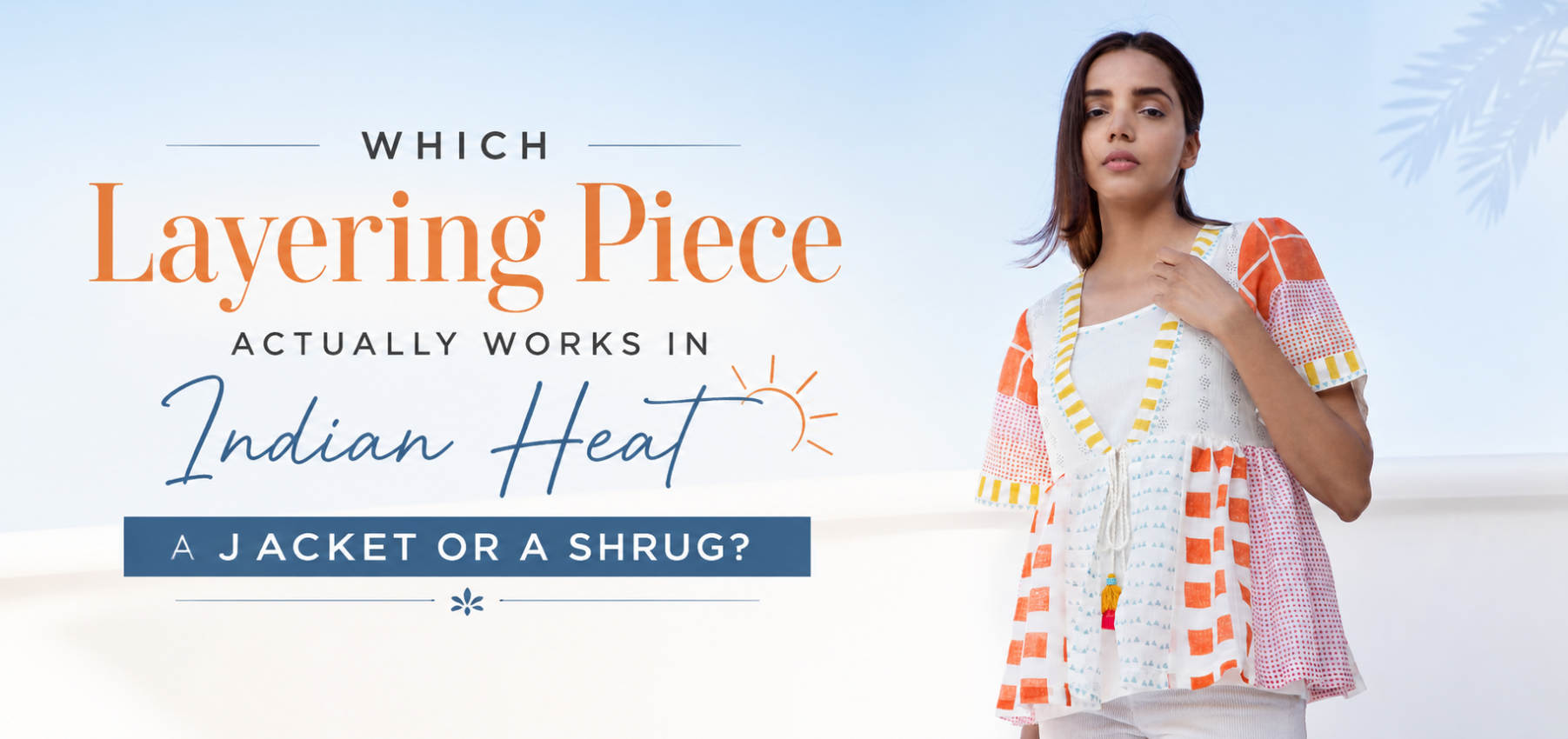
Which layering piece actually works in Indian heat — a jacket or a shrug?
Every Indian woman knows the dilemma. The morning starts cool, the afternoon turns scorching, and by evening you are either overdressed or underdressed depending on how optimistic you were at 8 a.m. Layering, in theory, solves this. But choosing the wrong layering piece can make the problem worse — not better.
This is a question that comes up often in Indian fashion conversations: when it comes to shrug vs jacket for Indian summer, which one actually earns its place in your wardrobe? Both layer over an outfit. Both add structure. But they behave very differently once the temperature climbs past 30 degrees — which, for most of India, is roughly nine months a year.
This guide looks at both pieces honestly — their fabrics, their fit, where they work and where they don't — so you can make a more informed choice for your wardrobe, your climate, and the way you actually dress.
Understanding the Indian Climate Challenge
India does not have one climate. A woman in Mumbai deals with coastal humidity that makes structured clothing feel suffocating. A woman in Jaipur faces dry, intense heat for most of the year. Delhi winters justify a jacket; Delhi summers absolutely do not. And in cities like Chennai or Hyderabad, the heat is consistent enough that even a light layer needs to be chosen with care.
What this means practically is that any layering piece worn in India needs to pass a simple test: does it make you more comfortable, or does it make you warmer? A piece that adds visual polish but raises your body temperature is not a practical choice for daily wear in this country.
This is where the conversation about jackets and shrugs becomes genuinely useful — because these two pieces have very different relationships with heat.
What a Jacket Does — and Where It Struggles in Indian Conditions
A jacket is a closed layering piece. It has two sides of fabric, usually a structured cut, and often some degree of lining or reinforcement at the seams. This is what gives it shape and formality — but it is also what makes it a poor choice for Indian summers.
The structure problem
Most jackets — whether they are denim, cotton canvas, or synthetic blazers — trap heat. The structured cut sits close to the body, reduces airflow, and in humid weather, creates the uncomfortable combination of warmth and moisture against the skin. Even a well-made cotton jacket can feel oppressive by mid-morning in a city like Lucknow or Pune during May or June.
Where jackets genuinely work in India
Jackets do have a place in the Indian wardrobe — specifically in winter (November through February in North India), in high-altitude travel, and in air-conditioned office environments where the temperature is maintained well below outdoor levels. For these contexts, a well-tailored jacket over a kurta or a coordinated dress with jacket set makes complete sense. It adds formality, warmth, and a polished finish.
The problem is when the jacket gets worn out of context — in warm outdoor settings, at afternoon events, or for travel that moves between environments. In those situations, it becomes more of a burden than a benefit.
What Makes a Shrug Better Suited to Indian Summers
A shrug is fundamentally different in construction. It is an open-front garment, typically without buttons or fastening, worn over a dress, kurta, or top. This open construction is its most important practical feature: it allows air to circulate continuously around the body, which makes a significant difference in warm weather.
Fabric choices that work for Indian heat
The best shrugs for Indian summers are made in cotton, chanderi cotton, or handloom cotton — fabrics that breathe, wick moisture away from the skin, and dry quickly. These materials do not cling in humidity, do not feel heavy after a few hours of wear, and maintain their shape through repeated washing, which matters when a garment is worn frequently.
Cotton and chanderi are also soft against the skin, which is important for a layering piece that sits directly over your arms throughout the day. This is one reason why a well-made cotton short shrug for women has become such a practical wardrobe staple for Indian women across age groups and occasions.
The open-front advantage
Because a shrug is open at the front, it does not constrict movement or trap heat against the torso. You get the visual layering effect — the sense of a complete, considered outfit — without the thermal burden of an additional closed layer. On a warm afternoon, this distinction is not trivial. It is the difference between staying comfortable and spending the rest of the day aware of how warm you are.
Ease of removal and portability
A shrug folds flat and fits into almost any bag. This matters for Indian women who move between environments throughout the day — from a warm outdoor setting to an air-conditioned office, from a morning meeting to an evening function. The shrug goes on and comes off in seconds, which a structured jacket simply cannot do as easily. For travel, for long event days, for any situation where your environment changes, this portability is a genuine practical advantage.
A Direct Comparison: Shrug vs Jacket for Indian Summer
Setting the two pieces side by side makes the differences clearer. Here is how they compare across the factors that matter most for Indian conditions:
Factor | Shrug | Jacket |
Breathability | High — open front allows constant airflow | Low to moderate — closed construction traps heat |
Best fabric for Indian heat | Cotton, chanderi, handloom cotton | Light cotton canvas (limited options) |
Suitable for 30°C+ weather | Yes | No — uncomfortable in high heat |
Office wear | Yes — pairs well over kurtas and dresses | Yes — but best in air-conditioned settings |
Festive occasions | Yes — especially in chanderi or embroidered styles | Yes — particularly coordinated jacket-dress sets |
Travel-friendly | Very — folds flat, lightweight | Less so — bulkier, needs careful packing |
Ease of styling | High — works over most Indian outfits | Moderate — requires more matching thought |
Best Indian season | Year-round — spring, summer, monsoon, early winter | Winter — November to February in North India |
The honest summary: For the majority of the Indian calendar year, a well-chosen shrug outperforms a jacket on almost every practical measure. It is not that jackets are not useful — they are, in the right season and setting. But if you are dressing for Indian summers specifically, a shrug is the more considered and more comfortable choice.
Which Occasions Call for Which Piece?
For everyday office and work wear
A lightweight shrug in a neutral or subtle block-printed cotton layers beautifully over a kurta or women cotton dresses for the office. It adds the sense of a complete, professional outfit without adding warmth. In an air-conditioned office, it also provides enough cover to stay comfortable without feeling overdressed.
For festive and family occasions
This is where the choice becomes more nuanced. A festive occasion — a Diwali gathering, a wedding function, a family celebration — often calls for something with more visual weight than a plain cotton shrug. For these occasions, a chanderi or cotton silk layering piece, or a golden shrug for women in a metallic weave, gives you the elevated look of occasion dressing without the heaviness of a full jacket or embroidered ensemble. Pair it with a solid-colour dress or kurta and let the shrug carry the festivity.
For travel and long event days
When you are moving between environments — outdoor venues, air-conditioned interiors, long drives — a shrug is the practical choice every time. It requires no thought to remove or add, takes up minimal space, and ensures you are comfortable regardless of the setting. A short shrug for ladies in a breathable handloom cotton is particularly well-suited to this kind of flexible dressing.
For formal or corporate settings in cooler months
This is where a structured jacket makes genuine sense. In November through February, particularly in North and Central India, the mornings are cool enough that a jacket over a shrug tops for women or kurta provides real warmth while maintaining a formal, polished silhouette. For women who prefer coordinated dressing, a well-tailored jacket-and-dress combination is also a strong choice for formal events in cooler weather.
How to Choose the Right Shrug for Your Wardrobe
Once you have decided that a shrug is the right layering piece for your needs, the next question is which kind. The answer depends on three things: your frame, your lifestyle, and the season you are dressing for.
Frame and proportion
Petite frames are best served by a cropped shrug that sits just below the hip — this length keeps the silhouette balanced without making the wearer appear shorter. Taller frames carry a longer shrug with more ease, and a bold block print or textured fabric reads particularly well on a taller silhouette. Most stylish shrugs for women available in handcrafted cotton are designed in this versatile, below-the-hip length precisely because it works across a range of body types.
Occasion and lifestyle
If you dress primarily for work, a shrug in a solid or subtly printed cotton or chanderi will serve you well every day of the week. If you attend a mix of casual, festive, and professional settings, consider having two — a plain or lightly printed daywear piece, and a more textured or embellished shrug for occasions that deserve a little more.
Fabric by season
For summer and monsoon, cotton and chanderi cotton are the clearest choices — both breathe exceptionally well in humidity. As the weather cools from October onward, a cotton silk or thicker handloom weave gives you the same open-front layering with a little more structure and warmth. By mid-winter, you may find yourself reaching for the jacket — and that is perfectly appropriate, because each piece has its season.
The guiding principle: Build your layering wardrobe around the climate you actually live in, not the climate that appears in fashion inspiration from other countries. For most Indian women, across most of the year, a well-made breathable shrug is the more practical, more comfortable, and often more elegant choice.
The Craft Dimension — Why Fabric and Make Matter
There is one more dimension to this conversation that is worth raising — the quality of the piece itself. A shrug made from a loosely woven synthetic fabric will feel uncomfortable in heat regardless of its open-front construction. The fabric choice is what determines whether a shrug actually performs in Indian conditions.
Handcrafted shrugs made in genuine cotton, chanderi, or handloom weaves have been designed — often over generations of textile tradition — for exactly the climate most Indian women live in. The weave structure of chanderi, for example, creates a natural lightness that allows air movement while maintaining an elegant drape. Block-printed cotton develops character with washing rather than deteriorating. These are not aesthetic choices alone — they are functional ones that determine how a garment behaves across seasons and repeated wear.
When you invest in a piece that is made with this kind of care, the shrug vs jacket for Indian summer question often answers itself. A thoughtfully made cotton shrug is simply better suited to the Indian context than most mass-produced jackets — not because of trend, but because of craft and climate.
Final Thoughts
Both jackets and shrugs have a place in an Indian woman's wardrobe. The question is not which one is superior in absolute terms — it is which one serves you better, in your city, in your season, for your occasions.
For most of the Indian year, and for most Indian women who move between warm outdoor environments and air-conditioned interiors, who attend a mix of casual, professional, and festive occasions, and who value comfort as much as appearance — a well-made shrug in a quality natural fabric is the stronger, more versatile, and more climate-appropriate choice.
A jacket earns its keep in winter and in genuinely formal settings. Outside of those contexts, it asks more of you — in warmth, in bulk, in inflexibility — than it gives back. A shrug, by contrast, works with the Indian environment rather than against it. That is not a small thing. That is exactly what a good wardrobe piece should do.
Explore The Yellow Bow's handcrafted collection of shrugs and layering pieces — made in breathable cottons and chanderi, designed for the Indian wardrobe across every season and occasion.
Frequently Asked Questions
Is a shrug better than a jacket for Indian summers?
For most Indian weather conditions, yes. A shrug is lighter, open-fronted, and made from breathable fabrics like cotton or chanderi — which makes it far more comfortable in heat and humidity than a structured jacket. Jackets are better suited for cooler months or highly air-conditioned environments.
Which fabric is best for a shrug in Indian heat?
Cotton and chanderi cotton are the most suitable fabrics for Indian summers. Both are lightweight, breathable, and moisture-wicking. Cotton handloom and cotton silk blends are also good choices for transitional weather or when you want slightly more structure for festive occasions.
Can I wear a shrug to a formal or festive occasion?
Absolutely. A well-chosen shrug — particularly in chanderi, cotton silk, or a metallic weave — works beautifully for festive occasions, wedding functions, and semi-formal gatherings. The key is pairing it with a solid or subtly patterned base outfit and keeping accessories minimal so the shrug becomes the focal point.
How long should a shrug be for everyday wear?
For everyday layering, a cropped shrug that sits just below the hip is the most versatile length. It works well over kurtas, co-ord sets, and western dresses without overwhelming the base outfit. Taller frames can carry a longer shrug well, which creates a clean vertical line through the silhouette.
Can a shrug replace a jacket entirely in an Indian wardrobe?
For the warmer six to eight months of the year in India, a shrug can comfortably replace a jacket for most occasions — office wear, casual outings, festive events, and travel. A structured jacket remains useful for cooler North Indian winters (November to February) or formal settings that require a more enclosed, tailored silhouette.
-
 August 26th, 2026
 -
Natural vs Synthetic Fabrics: What Should You Know Before Buying?
August 24th, 2026 -
 August 24th, 2026
 -
 August 13th, 2026