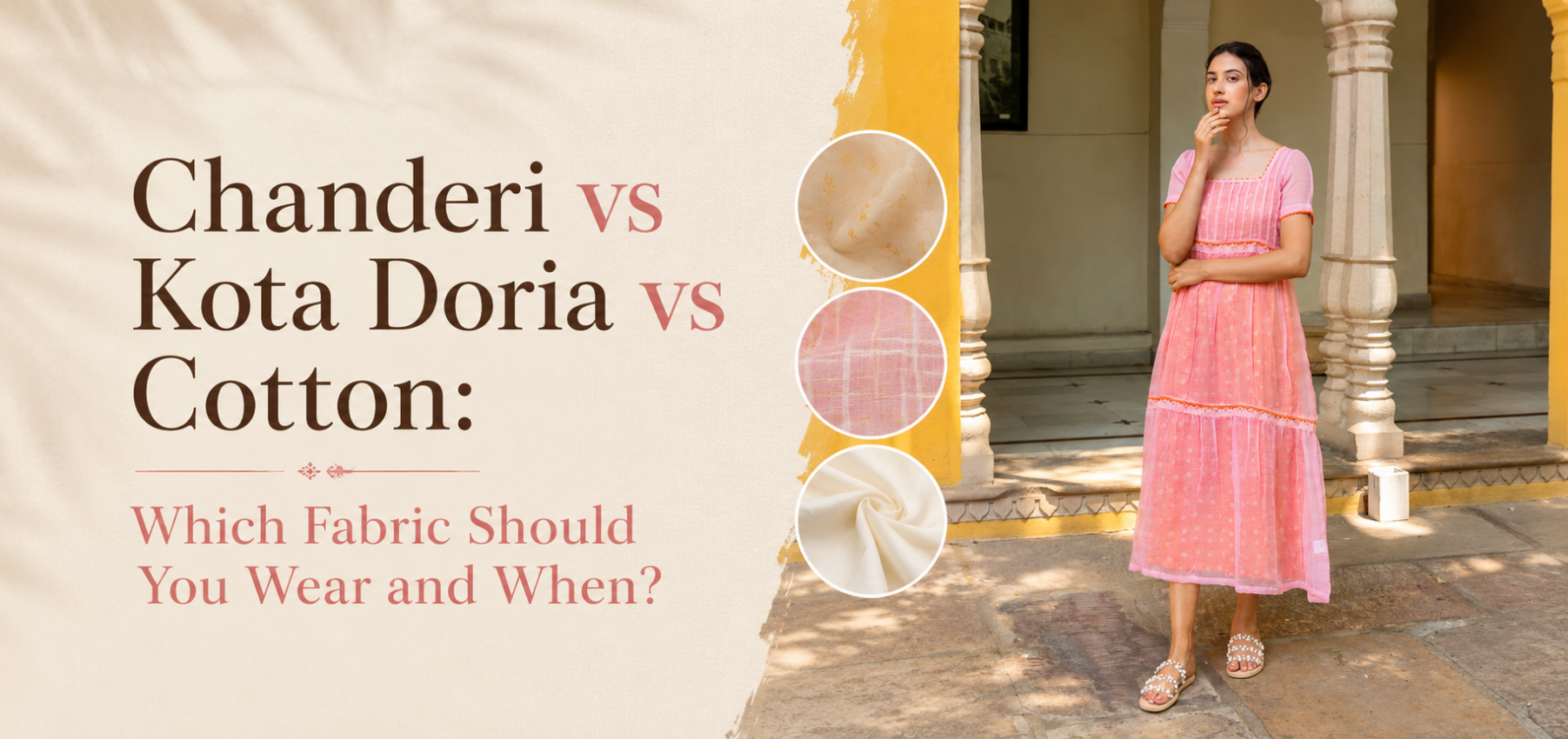
Chanderi vs Kota Doria vs Cotton: Which Fabric Should You Wear and When?
Three fabrics. All Indian. All breathable. All beloved. Yet Chanderi, Kota Doria, and cotton are as different from each other as the regions that produce them. If you have ever stood at a shop wondering whether to pick up a Chanderi kurta or a Kota Doria saree — or simply reached for cotton out of habit without really knowing what else is out there — this guide is for you.
We break down the character, history, occasion suitability, and care requirements of each fabric so you can make a decision that suits your body, your climate, and your life — not just your outfit.
Why the Fabric You Choose Matters More Than You Think
Most women choose garments by silhouette or print first, and fabric second. But experienced dressers know that fabric is the foundation. The same kurta silhouette in Chanderi and in plain cotton will feel, drape, and read entirely differently. One will shimmer softly; the other will sit crisp and matter-of-fact. Both have their moment. The question is knowing which moment belongs to which fabric.
In India's extreme climate — where summer temperatures regularly cross 40°C, monsoon humidity clings, and winter festivities demand elegance — fabric choice is not a style preference. It is a practical decision with real consequences for how comfortable, confident, and appropriate you feel through the day.
"The right fabric does not just dress you — it works with your body, your weather, and your occasion. Get it right, and everything else falls into place."
Understanding Chanderi — India's Fabric of Quiet Elegance
Chanderi comes from the small town of the same name in Madhya Pradesh, where weavers have been working this fabric for over 700 years. It is traditionally produced from a blend of silk and cotton — with the silk giving it a translucent, luminous body and the cotton keeping it light and relatively breathable.
The defining quality of Chanderi is its simultaneous lightness and richness. It feels expensive without feeling heavy. It drapes with a natural flow and catches light in a way that few other fabrics do — making even a simple silhouette look considered and polished. When you see a woman at a family function who looks effortlessly dressed without having tried too hard, there is a good chance she is wearing Chanderi.
In contemporary fashion, Chanderi has found excellent use beyond sarees. Chanderi tops and coordinated sets in Chanderi are increasingly popular for women who want occasion-worthy dressing without committing to a full saree. The fabric's sheen and drape do the work of looking special, so the styling can stay minimal.
Best suited for: Festive gatherings, family occasions, cultural events, semi-formal dressing, sarees, and elevated everyday wear.
Understanding Kota Doria — Rajasthan's Breathable Masterpiece
Kota Doria originates from the city of Kota in Rajasthan — a fitting birthplace, given that Rajasthan's desert climate demands the most breathable fabric possible. The defining characteristic of Kota Doria is its distinctive khat — a square check pattern formed by the weave itself, visible when the fabric is held up to light. This open, mesh-like structure is what gives Kota Doria its legendary breathability.
Kota Doria is available in pure cotton and in a cotton-silk blend. Pure cotton Kota is the more casual, more washable version — ideal for summer daily wear. The cotton-silk Kota has a slight shimmer and a finer hand, making it suitable for more dressed-up occasions while retaining all the breathability of the weave.
The fabric is particularly cherished for sarees, but it also makes excellent material for dupattas, lightweight kurtas, and scarves. A Kota Doria saree during Indian summer is one of those rare experiences where you can be dressed traditionally and still feel entirely comfortable through a long day.
Best suited for: Summer occasions, daytime events, casual ethnic wear, everyday sarees, travel, festive dressing in hot weather.
Understanding Cotton — The Fabric That Never Needs Justification
Cotton needs no introduction in India — it has clothed the subcontinent for millennia. But not all cotton is equal. Handloom cotton, produced on manually operated looms across states like West Bengal, Andhra Pradesh, and Tamil Nadu, has a different character from mill-spun cotton. It has a slightly irregular texture, a more natural hand, and often a depth of weave that machine-made cotton cannot replicate.
Within cotton, varieties matter. Mul cotton (malmal) is gossamer-fine and among the softest natural fabrics in the world. Dobby cotton has a raised geometric texture. Plain weave handloom cotton is crisp and structured. Each of these behaves differently when cut, sewn, and worn.
Cotton is the fabric that accepts hand block printing most generously. The ink absorbs into the natural fibres with depth and clarity, which is why the most beautiful block-printed garments are almost always on cotton. A hand block printed dress in quality handloom cotton has a visual warmth and character that synthetic alternatives simply cannot achieve.
Best suited for: Daily wear, office, travel, summer dressing, casual outings, and any context where comfort and ease of care come first.
Chanderi, Kota Doria, and Cotton Side by Side — A Detailed Comparison
When the question is which fabric to reach for, the following breakdown offers a clear, practical comparison across the most important criteria for Indian women's dressing.
Parameter | Chanderi | Kota Doria | Cotton (Handloom) |
Origin | Chanderi, Madhya Pradesh | Kota, Rajasthan | Pan-India (various states) |
Composition | Silk + Cotton blend | Cotton or Cotton + Silk | Pure Cotton |
Breathability | Good | Excellent (open mesh weave) | Very good |
Drape | Flowing, luminous | Light, slightly stiff | Varies by weave (structured to flowing) |
Sheen / Finish | Subtle, natural sheen | Matte to slight sheen (silk blend) | Matte, natural |
Occasion Suitability | Festive, semi-formal, daily | Summer occasions, casual ethnic | Daily, casual, travel, work |
Accepts Block Printing? | Yes — beautifully | Yes — with softness | Best — deepest colour absorption |
Care Requirements | Dry clean or cold gentle wash | Hand wash (cotton); dry clean (silk blend) | Hand or gentle machine wash |
Price Range | Moderate to premium | Moderate | Affordable to moderate |
Which Fabric to Wear in Each Indian Season
India's seasons are extreme and varied. Fabric choice should respond to season as much as occasion. Here is a clear breakdown by weather.
Peak Summer- Kota Doria and Mul cotton are the clear frontrunners. Both breathe exceptionally well. Chanderi in lighter weaves also works if you have a daytime function. Avoid heavy silk blends.
Monsoon- Lightweight cotton is your best companion — it dries quickly and handles humidity well. Kota Doria cotton works too. Avoid Chanderi in peak monsoon as it is slower to dry and needs more delicate handling.
Festive & Winter- Chanderi comes into its own here. The slight warmth of the silk content suits cooler weather, and the festive calendar aligns perfectly with Chanderi's formal appeal. Cotton works well layered with shrugs or jackets.
So, Which Is the Best Lightweight Fabric for Indian Summers?
This is arguably the most searched question among Indian women when wardrobe season begins. The answer depends on how you define "lightweight."
In terms of pure breathability and weight, Kota Doria wins. Its open mesh weave allows more air circulation than almost any other Indian fabric. If you are spending a summer day outdoors, at a day wedding, or travelling in heat, Kota Doria will keep you the most comfortable.
In terms of the best lightweight fabric that also works at a festive or semi-formal setting, Chanderi is the superior choice. It is light enough for warm weather but rich-looking enough for occasions where you want to be properly dressed. A printed Chanderi saree at a summer wedding is a widely tried and trusted combination for good reason.
And if what you need is the best lightweight fabric for everyday life — morning routines, errands, office hours, and everything in between — handloom cotton remains unmatched. It is the fabric that asks the least of you while giving you the most in terms of comfort and wearability.
How to Style Each Fabric — Practical Notes for Everyday Women
Styling Chanderi
Chanderi's natural luminosity means it does not need much help. Keep accessories simple — small gold earrings and a clean bindi take a Chanderi outfit from tasteful to complete. For contemporary styling, a Chanderi kurta paired with straight-fit pants or wide-leg trousers in a complementary tone looks polished without effort. For women who prefer co-ordinated dressing, exploring tunic sets for women in Chanderi is a particularly elegant option for festive occasions.
Styling Kota Doria
Kota Doria's light, slightly translucent body works best when layered thoughtfully. In saree form, a contrasting or printed blouse adds visual interest. As a dupatta over a plain kurta, Kota Doria adds texture without heaviness. The fabric responds well to block or screen printing, so printed Kota garments offer the breathability of the weave with the visual richness of crafted pattern. A lightly printed top in Kota cotton — worn with comfortable trousers — is the definition of effortless summer dressing. For similar everyday ease in coordinated form, women cotton co-ord sets in lightweight cotton offer a close seasonal alternative.
Styling Cotton
Cotton's greatest styling gift is its versatility. It can be dressed up with embellishment or down with simplicity. Block-printed cotton pieces particularly reward relaxed, minimal styling — let the print speak, keep the accessories quiet. A printed top in handloom cotton paired with solid trousers or a skirt is a reliable, comfortable formula. For women who want the ease of a ready-to-wear look, women printed tops in handloom cotton with a block print are an ideal starting point for building a wardrobe that is both practical and visually interesting.
A Quick Word on Block Printing Across These Three Fabrics
All three fabrics accept hand block printing, but the results differ in character. On cotton — especially Mul cotton or plain handloom cotton — block prints sit with the deepest pigment saturation and the most defined edges. The result is bold and clear.
On Chanderi, block prints take on a softer, more diffused quality because of the silk content. The sheen of the base fabric makes colours appear slightly lighter and more luminous — the print feels more subtle and refined. This is why block-printed Chanderi garments often look more formal than the same print on cotton.
On Kota Doria, the open mesh weave means prints have a slightly textured appearance — the colour sits on a surface that has natural light and shadow built into it from the weave. This gives Kota block prints a unique depth that is distinctly different from flat cotton.
Each combination has its own visual personality. Understanding this helps you choose not just the fabric, but the printed garment that will look exactly the way you intend it to.
"Chanderi makes you look like you made an effort. Kota Doria makes you feel like you did not have to. Cotton makes you forget you are wearing anything at all. All three are correct."
Care Guide for All Three Fabrics
Knowing how to care for your fabric ensures your garments last years, not seasons.
Fabric | Washing | Drying | Ironing | Storage |
Chanderi | Dry clean preferred; cold gentle hand wash if needed | Shade dry flat | Low heat, reverse side, cloth in between | Cotton muslin bag, fold with acid-free paper |
Kota Doria (Cotton) | Cold hand wash, mild detergent | Hang to drip-dry in shade | Low-medium heat while slightly damp | Breathable cotton bag |
Kota Doria (Silk Blend) | Dry clean or very gentle cold hand wash | Flat shade dry | Low heat with pressing cloth | Breathable bag away from direct light |
Cotton (Handloom) | Hand wash or gentle machine cycle in cold water | Hang in shade or lay flat | Medium heat while slightly damp | Any breathable storage; avoid plastic |
Frequently Asked Questions
What is the difference between Chanderi and Kota Doria fabric?
handeri is a silk-cotton blend woven in Madhya Pradesh, known for its subtle sheen and translucent body. Kota Doria is a pure cotton or cotton-silk weave from Rajasthan, recognised by its distinctive square-check pattern (khat) and open, mesh-like texture. Chanderi is slightly dressier; Kota Doria is slightly more casual and even more breathable.
Which is better for summer — Chanderi, Kota Doria, or Cotton?
All three are excellent summer fabrics. Kota Doria wins on pure breathability due to its open mesh weave. Mul cotton and plain handloom cotton are the most practical for daily summer wear. Chanderi is the best choice when you want a summer fabric that can also work at a festive or semi-formal occasion.
Can Chanderi fabric be worn daily or is it only for occasions?
Chanderi can absolutely be worn daily, especially in its cotton-dominant or lighter weaves. Chanderi tops, kurtis, and coordinated sets in Chanderi fabric are increasingly popular for office and everyday use. The key is the silhouette — a relaxed Chanderi top or tunic is comfortable enough for daily wear while retaining an effortlessly polished look.
Is Kota Doria fabric easy to maintain at home?
Yes. Pure cotton Kota Doria can be hand washed gently in cold water. Silk-blend Kota Doria is best dry cleaned or given a very light cold water hand wash. The open weave means it dries quickly. Avoid wringing or machine washing to preserve the distinctive khat (square check) texture.
Which fabric is most versatile — Chanderi, Kota Doria, or Cotton?
Plain handloom cotton is the most versatile overall — it works for daily wear, travel, casual occasions, and even semi-formal settings when styled well. Between Chanderi and Kota Doria, Chanderi is more versatile for occasion dressing, while Kota Doria excels as a summer-specific fabric. The best choice depends on your primary use case.
-
 August 26th, 2026
 -
Natural vs Synthetic Fabrics: What Should You Know Before Buying?
August 24th, 2026 -
 August 24th, 2026
 -
 August 13th, 2026