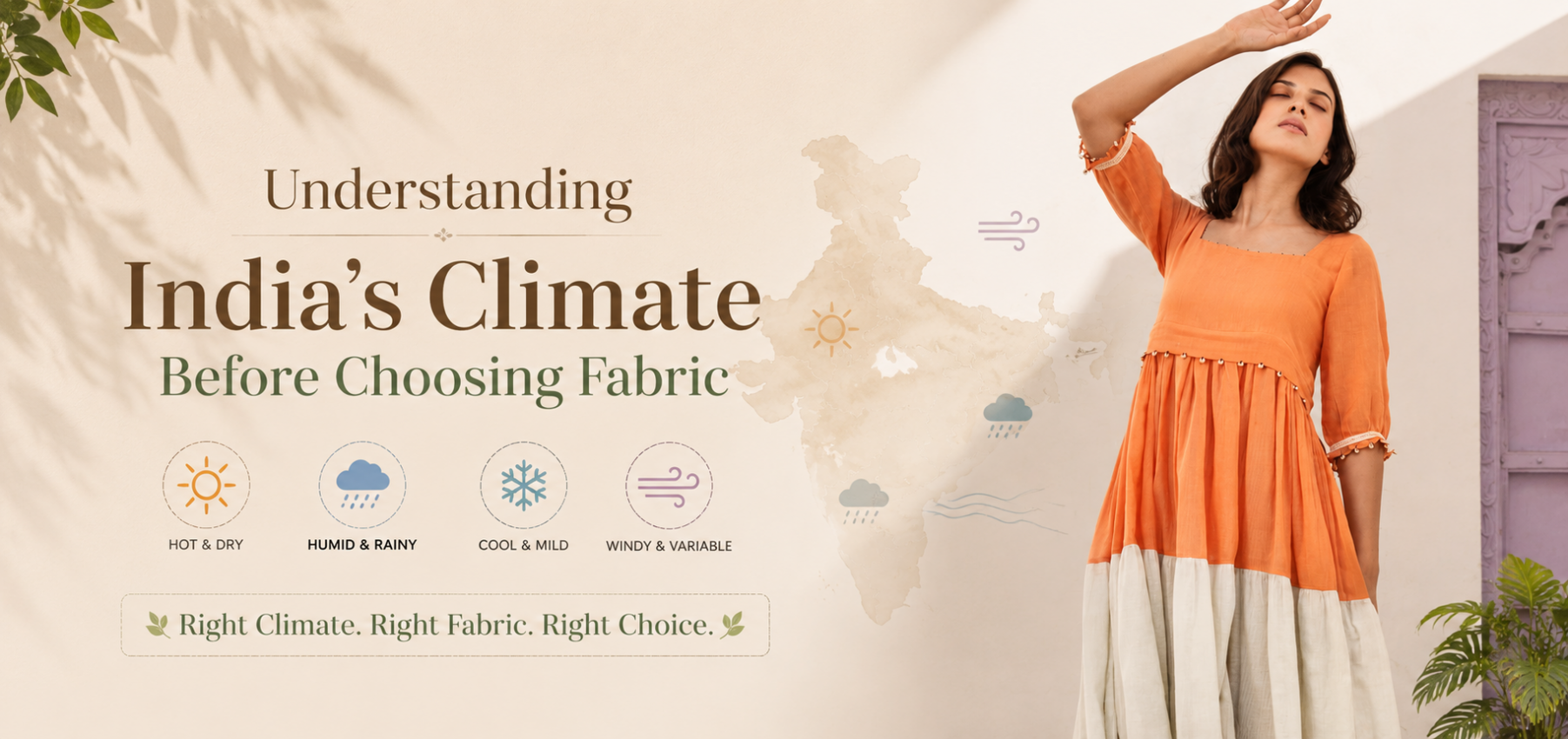
Understanding India's Climate Before Choosing Fabric
Clothing is not just about fashion — in India, it is deeply tied to the environment. A country that stretches from the snow-capped Himalayas to the tropical coastlines of Kerala, and from the arid Thar Desert to the lush forests of the Northeast, India is a land of extraordinary climatic diversity. What you wear in Jaipur in May is entirely different from what works in Kochi in September or Shimla in January.
Yet many of us choose fabrics based on trends, aesthetics, or habit — not the actual climate we live in. This disconnect leads to discomfort, skin irritation, excessive sweating, and clothes that wear out too quickly. Understanding how India's climate zones and seasonal shifts interact with different textiles is the foundation of building a truly functional, beautiful wardrobe.
This is your complete climate based fabric guide — one that reads India's weather honestly and matches it with textiles that have stood the test of time.
Quick Answer: India has four broad seasons — Summer (March–June), Monsoon (July–September), Post-Monsoon (October–November), and Winter (December–February). Each season and each region of India demands different fabric choices. Cotton dominates Indian summers; lightweight handlooms like Chanderi suit transitional months; and layering in breathable fabrics is key during winter in North India.
Why India's Climate Is Unlike Any Other Country
India is not a single-climate country. The Indian Meteorological Department recognises multiple climatic zones — arid, semi-arid, tropical, subtropical, coastal, highland, and more. This means fabric advice that works in London or Paris is almost never applicable here.
Consider the contrast: Delhi can hit 47°C in May with dry, parching heat, while Chennai maintains a sticky humidity of 80–90% almost year-round. Kolkata endures a relentless monsoon while Ladakh barely sees rain. Mumbai transitions quickly from humid summers to heavy rains to pleasant winters. This diversity makes fabric selection a genuinely regional and seasonal decision — not a one-size-fits-all choice.
What unites most of India's climate, however, is heat. Even in winter, large parts of the country experience temperatures that make heavy woollen fabrics impractical. Indian weather calls for fabrics that breathe, absorb sweat, dry quickly, and feel gentle against the skin. This is precisely why India's own traditional textiles — cotton, handloom weaves, Chanderi, and khadi — have thrived here for centuries. They were designed for this land.
India's Four Seasons and the Fabrics That Belong to Each
Season 1: Indian Summer (March to June) — The Season of Breathable Fabrics
Indian summers are intense. Northern and central India experience scorching dry heat, while coastal cities like Mumbai and Chennai become humid and sweltering simultaneously. This is when fabric choice directly impacts your physical comfort throughout the day.
Best fabrics for Indian summer: Pure cotton leads the list for a reason — it is a natural, breathable fibre that wicks moisture away from the skin and allows air circulation. Handwoven cotton is especially valued because its looser weave structure promotes ventilation. Cotton voile and mulmul (muslin) are lighter variants of cotton that feel almost weightless in the heat.
A hand block printed dress in pure cotton, for instance, is not simply an aesthetic choice — the breathable fabric, the relaxed silhouette, and the natural dyes work together to make it genuinely comfortable during summer days, whether you are commuting, working, or attending a casual gathering.
Fabrics to avoid in summer: Polyester, nylon, and synthetic blends trap heat and create a greenhouse effect against your skin. Thick silks and heavy brocades are equally unsuitable. Even linen, often promoted as a summer fabric, can feel stiff in Indian humidity if not blended carefully.
Style Tip: For Indian summer dressing, look for loose silhouettes in light cotton. Flowy hemlines, wide sleeves, and open necklines all help with ventilation. Light colours also reflect sunlight rather than absorbing it, which makes a real difference in outdoor settings.
Season 2: The Monsoon (July to September) — Fabrics That Can Handle Rain and Humidity
The Indian monsoon is beloved and challenging in equal measure. It brings relief from the summer heat but introduces a new set of fabric considerations — humidity, moisture, slow drying times, and the constant risk of getting caught in unexpected downpours.
Best fabrics for monsoon: Cotton remains a strong choice during the monsoon, especially in darker shades or bold prints that don't show watermarks easily. Cotton dries relatively quickly compared to silk or thick synthetics. cotton block print dresses are a particularly smart monsoon choice — the prints add character, the fabric handles humidity well, and darker or earth-toned block print motifs mask light splashes gracefully.
Cotton-modal blends are also gaining popularity for monsoon dressing because modal adds a slightly smoother texture and superior moisture management compared to plain cotton.
Fabrics to avoid during monsoon: Raw silk, heavy silk, and thick khadi are problematic in the monsoon — they take a long time to dry, can develop a musty smell, and may lose their sheen when repeatedly damp. Chiffon and georgette, while lightweight, are nearly impossible to manage in heavy rain and lose their drape when wet.
Season 3: Post-Monsoon / Transition (October to November) — The Golden Window for Heritage Textiles
The weeks following the monsoon are arguably the most pleasant in most parts of India. Temperatures cool slightly, humidity drops, and the air carries that post-rain freshness. This is the season of festivals — Navratri, Dussehra, Diwali — and the season when Indian women most consciously dress up.
This transitional period is ideal for bringing out handloom textiles with a little more body and sheen. Chanderi, a handloom fabric from Madhya Pradesh, is one of the finest choices for this season. It is light enough not to feel heavy in residual warmth, yet carries a natural luminosity that makes it deeply festive.
A handloom chanderi saree is a quintessential post-monsoon garment — it drapes elegantly, breathes well, and suits the festive occasions of October and November without making the wearer feel overdressed or overheated. Its characteristic shimmer comes from interwoven silk or zari threads, giving it a festive quality that heavier silks deliver at a fraction of the weight.
This is also the right season to explore printed chanderi sarees, which layer traditional handloom texture with contemporary block or screen prints, making them versatile for both cultural occasions and modern festive gatherings.
Style Tip: Post-monsoon evenings can still carry some warmth, so pair your festive Chanderi outfit with minimal layering. A lightweight cotton stole or short jacket is enough to manage the slight temperature drop after sunset.
Season 4: Indian Winter (December to February) — Layering Smartly in Indian Fabrics
Winter in India is not uniform. North India — particularly Delhi, Jaipur, and Lucknow — experiences genuine cold that can dip to single-digit temperatures at night. South India and coastal cities barely register a drop below 20°C, making their "winter" a matter of light layering. The hills and mountain states experience true cold weather.
For most urban Indian women, winter dressing is about smart layering rather than heavy fabrics. The goal is to stay warm during the morning commute and cool enough indoors, where heating is used far less than in European or North American contexts. This makes rigid, heavy woollen outfits impractical for everyday wear.
Layering pieces in Chanderi, cotton-silk blends, or textured handloom fabrics allow women to build warmth without bulk. This is where shrug tops for women in fabrics like Chanderi or handwoven cotton become genuinely useful — they add a stylish layer over a base outfit without the heaviness of a full coat or shawl.
For more formal or festive winter occasions, structured Chanderi Tops and jacket sets in cotton or Chanderi blends provide elegance with warmth, making them ideal for winter weddings, holiday gatherings, and cultural events.
A Region-by-Region Climate Fabric Guide for India
Beyond seasons, geography matters. Here is a concise breakdown for women dressing for specific Indian climate zones:
Region | Climate Type | Best Fabrics Year-Round | Seasonal Consideration |
North India (Delhi, Jaipur, Lucknow) | Extreme — very hot summers, cold winters | Cotton (summer), Handloom + Light Wool Blend (winter) | Layering essential in Dec–Feb; pure cotton critical May–June |
South India (Chennai, Bengaluru, Hyderabad) | Hot and humid, mild winters | Cotton, Cotton-Modal, light handlooms | Cotton year-round; light Chanderi for festive Oct–Nov |
Western India (Mumbai, Pune, Ahmedabad) | Hot + heavy monsoon | Cotton, quick-dry blends | Heavy monsoon demands practical, quick-dry cottons Jul–Sep |
Eastern India (Kolkata, Bhubaneswar) | Humid subtropical | Cotton, light Handloom | High humidity; avoid thick fabrics except brief Dec–Jan window |
Central India (Bhopal, Nagpur, Indore) | Semi-arid, hot summers | Cotton, Chanderi (MP's own handloom) | Chanderi thrives here — it originates from this region |
Coastal India (Goa, Kochi, Mangalore) | Tropical, always humid | Light cotton, cotton voile | Moisture management is the priority throughout the year |
Why Traditional Indian Textiles Are the Original Climate Based Fabric Guide
It is worth pausing to acknowledge something remarkable: India's ancient textile traditions were never just art. They were climate science in fabric form.
Muslin from Dhaka, Chanderi from Madhya Pradesh, Mangalgiri cotton from Andhra Pradesh, Kota Doria from Rajasthan — each of these handloom traditions emerged in specific geographic and climatic contexts. The weavers of these regions were not following fashion trends; they were solving the precise problem of how to dress comfortably in their particular climate. The open weave of Kota Doria, for instance, is a structural response to the heat of Rajasthan. The light shimmer of Chanderi was designed for the post-monsoon festive season of central India.
When you choose Indian handloom textiles, you are not just making an aesthetic or ethical choice — you are choosing fabrics that have been climate-tested over centuries in the very conditions you are dressing for.
Hand block printing on cotton, another ancient tradition from Rajasthan and Gujarat, adds visual character without altering the breathability of the base fabric. This is why block printed cotton garments — from everyday dresses to festive kurtas — remain a staple of Indian wardrobes across every season and every region.
Common Fabric Mistakes Indian Women Make and How to Avoid Them
Wearing polyester in summer because it "looks crisp"
Polyester may hold its shape well, but it is one of the worst fabrics for Indian heat. It does not absorb sweat, traps body heat, and can cause rashes and skin irritation. Even polyester-cotton blends are problematic in peak summer. If you want a structured, crisp look in summer, choose cotton poplin or a well-finished handloom cotton — they can look equally polished without the discomfort.
Reserving cotton "only for casual wear"
There is a widespread perception in India that cotton is informal and silk is dressy. This is an outdated idea. A beautifully cut cotton dress with a hand block print, or a tailored cotton occasion set with jacket, can be just as elegant as any silk outfit — and far more appropriate for a country as warm as India. Contemporary Indian brands have done remarkable work in elevating cotton to occasion wear without compromising on its climate-friendly properties.
Ignoring regional climate when building a wardrobe
Fashion advice and wardrobe guides in India are often written for a single city — usually Delhi or Mumbai. Women in Chennai, Kochi, or Bhubaneswar have different climatic needs. Coastal women may need quick-dry fabrics more than insulating ones. Women in Jaipur need both extremes. Understanding your own city's climate pattern is the most practical starting point for building a wardrobe that works.
Buying heavy silks for every festive occasion
India's festive calendar falls largely between August and February — months when temperatures vary enormously by region. Wearing a heavy silk saree at a Navratri celebration in October in Hyderabad can be genuinely uncomfortable. Lightweight handlooms like Chanderi or silk-cotton blends give you the festive sheen without the weight and warmth of heavier silks.
Building a Climate-Smart Indian Wardrobe: Practical Principles
A truly functional Indian wardrobe does not need to be large — it needs to be well-considered. Here are the principles that guide a smart, climate-aware approach to dressing in India:
Anchor with cotton. For most Indian women living in plains cities, cotton in its many forms — plain, printed, handloom, mulmul — should form the backbone of the wardrobe. It is the most versatile, climate-appropriate, and sustainable choice available.
Add one or two handloom fabrics for the festive season. Chanderi, Kota, or silk-cotton blends in sarees, tops, or occasion wear give you the range to dress up for celebrations without investing in heavy silks that will only work in air-conditioned rooms.
Layer thoughtfully, not heavily. Indian winters, for most of the country, are about light layering. A well-designed shrug or light jacket in cotton or Chanderi adds warmth and visual interest without turning your outfit into a winter coat. This is especially useful for morning-to-evening occasions where temperatures change significantly.
Choose prints and colours seasonally. Lighter, cooler tones and open motifs feel appropriate in summer; richer, deeper shades and elaborate block prints feel at home in the festive post-monsoon months. This is not a rigid rule but a natural rhythm that most Indian dressers intuitively follow.
Trust Indian textile traditions. They were built for this climate. When in doubt, return to the handloom weaves, the block prints, the natural fibres — they have been solving the Indian climate problem for centuries.
Frequently Asked Questions
Which fabric is best to wear in Indian summers?
Pure cotton is the best fabric for Indian summers. It is breathable, moisture-absorbing, and keeps the body cool even in extreme heat. Handloom cotton and cotton block print dresses are particularly recommended for daily wear during the hot months of March to June.
What should I wear during the monsoon season in India?
During the Indian monsoon, opt for fabrics that dry quickly and resist moisture damage. Cotton and cotton-blend fabrics in darker shades or prints are ideal. Avoid heavy silks and raw fabrics that take long to dry. Lightweight cotton dresses and printed cotton outfits are practical and stylish choices.
Is Chanderi fabric suitable for all seasons in India?
Chanderi is a versatile Indian handloom fabric best suited for post-monsoon (October–November) and mild winters. Its light sheen and semi-sheer texture make it comfortable in moderate temperatures and ideal for festive and formal occasions. It is less recommended for peak summers or humid monsoon months.
How do I choose the right fabric for North vs South Indian climate?
North India experiences extreme seasons — very hot summers and cold winters — so fabrics like cotton for summer and layered cotton or wool-blend for winter work best. South India and coastal regions are hot and humid year-round, making breathable cotton an all-season fabric. Lightweight handloom fabrics work well across both regions during transitional months.
What layering pieces work best for Indian transitional seasons?
Transitional seasons in India (February–March and October–November) call for light layering. Lightweight shrug tops for women made from cotton or Chanderi fabric are ideal — they can be slipped on or off as temperatures fluctuate. They pair well with cotton dresses and kurtas for a put-together look without the heaviness of a full jacket.
-
 August 26th, 2026
 -

Natural vs Synthetic Fabrics: What Should You Know Before Buying?
August 24th, 2026 -
 August 24th, 2026
 -
 August 13th, 2026