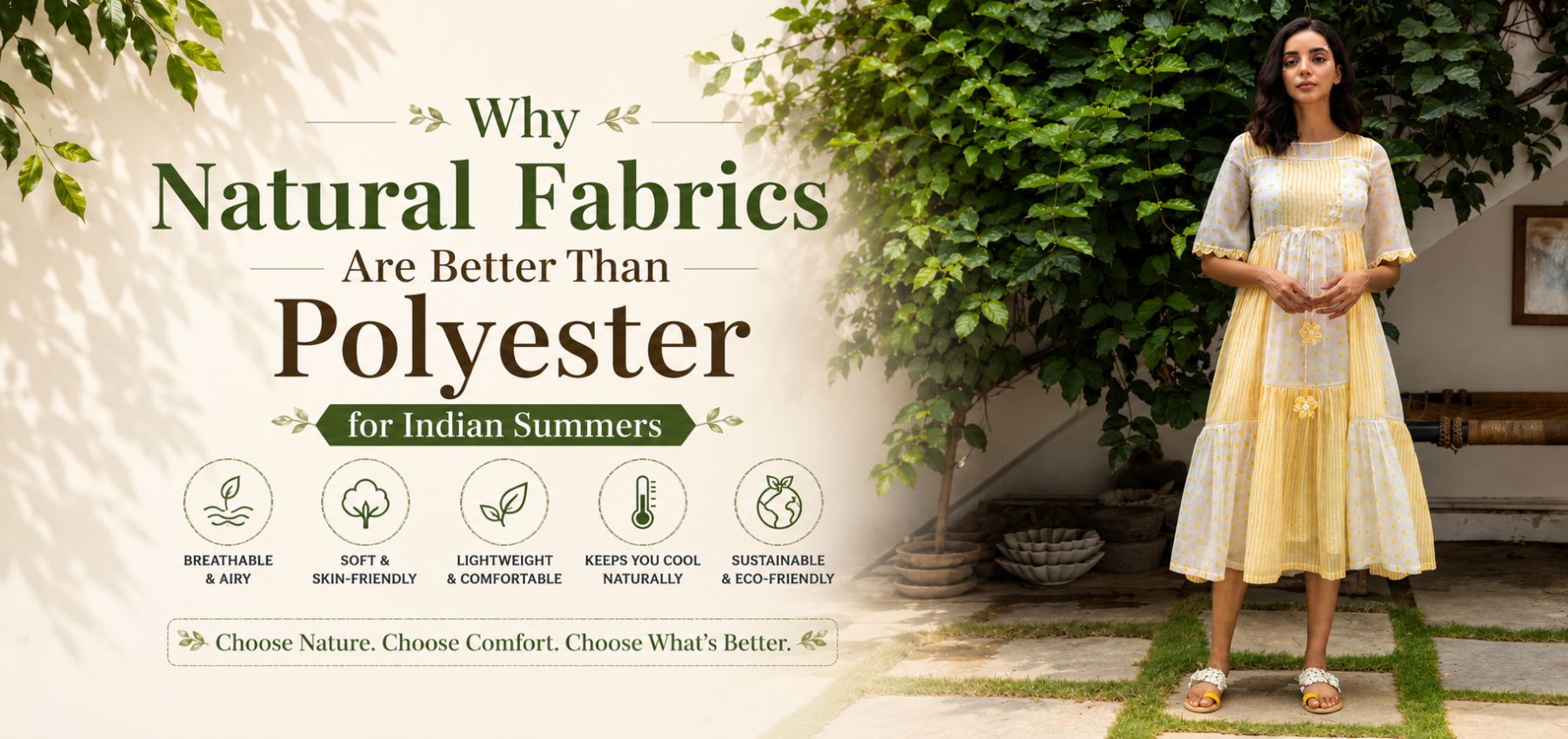
Why Natural Fabrics Are Better Than Polyester for Indian Summers
Every May, millions of Indian women make the same mistake — they reach for a crisp, colourful outfit that looks neat on the hanger, step out into 42°C heat, and within an hour wish they had chosen something entirely different. More often than not, the culprit is polyester.
Polyester dominates the Indian fast-fashion market. It is cheap to produce, easy to print on, resistant to wrinkles, and retains colour well after washing. On paper, it sounds like a practical fabric. In the reality of an Indian summer, it is the opposite. It traps heat, holds sweat against your skin, generates static, and can cause rashes and skin irritation in temperatures that regularly cross 40°C across large parts of the country.
The question of natural fabrics vs polyester is not simply a matter of preference or environmental values — it is a matter of physical comfort, skin health, and practical wearability in one of the hottest climates on earth. This guide breaks down the science, the experience, and the textile wisdom behind choosing natural fabrics for Indian summers.
Quick Answer: Natural fabrics like cotton, handloom weaves, and Chanderi allow air to circulate, absorb sweat, and keep the body cool. Polyester does none of these things — it is a plastic-based fibre that traps heat and moisture. In Indian summers where temperatures regularly exceed 38–45°C, natural fabrics are not just more comfortable — they are the medically and practically superior choice.
What Actually Happens to Your Body in Polyester During an Indian Summer
To understand why fabric choice matters so deeply in India, it helps to understand what happens physiologically when you wear polyester in extreme heat.
The human body regulates its temperature primarily through sweating. When sweat evaporates from the skin's surface, it carries heat away from the body — this is the body's natural cooling mechanism. For this system to work, the fabric covering your skin needs to allow two things: moisture absorption and air movement.
Polyester fails at both. As a petroleum-based synthetic fibre, polyester has virtually no moisture absorbency — it absorbs less than 0.4% of its weight in water, compared to cotton's 8–10%. This means sweat cannot move away from the skin. Instead, it stays trapped between the fabric and the body, creating a warm, damp microenvironment that prevents the cooling evaporation process from happening at all.
The result is familiar to anyone who has worn polyester on a hot Indian day: persistent dampness, visible sweat patches, a feeling of being wrapped in a warm film, and — particularly in cities like Delhi, Jaipur, Hyderabad, or Nagpur where temperatures are both high and dry — a sense of being slowly cooked.
Skin Health Note: Dermatologists in India frequently cite synthetic fabrics as a contributing factor in heat rashes (prickly heat), contact dermatitis, and fungal skin infections during summer months. The combination of trapped moisture, heat, and synthetic fibres creates conditions where skin bacteria and fungi thrive.
The Science Behind Why Cotton Breathes — and Polyester Does Not
Natural fibres like cotton, linen, and silk are derived from biological sources — plants or animals. At the microscopic level, they have a structure that polyester simply cannot replicate. Cotton fibres, for instance, are hollow at their core. This hollow structure allows them to absorb moisture and hold it away from the skin while also facilitating air movement through the weave.
Handwoven cotton — the kind used in traditional Indian textiles — has an additional structural advantage: hand-weaving typically produces a slightly looser, more open weave compared to machine-made fabric. This further improves air circulation through the garment. It is why a hand-woven cotton kurta from a craft-conscious brand feels noticeably cooler than a machine-woven cotton shirt of similar weight.
Polyester fibres, by contrast, are solid synthetic threads. They have no hollow core, no moisture-absorbing capacity, and no inherent ventilation. Even tightly woven polyester cannot compensate for these structural deficiencies. No amount of weave manipulation gives polyester the breathability of a natural fibre.
This is why a hand block printed dress in pure cotton — despite being fully covered — can feel genuinely cool on a hot afternoon, while a polyester dress of the same coverage becomes unbearable within minutes of stepping into the sun.
Cotton vs Polyester for Indian Summer: A Direct Comparison
Property | Pure Cotton | Polyester |
Moisture Absorption | ✔ Absorbs 8–10% of its weight in sweat | ✘ Absorbs less than 0.4% — sweat stays on skin |
Breathability | ✔ Open fibre structure allows air circulation | ✘ Solid synthetic threads block airflow |
Heat Regulation | ✔ Supports sweat evaporation — cools the body | ✘ Traps heat against the skin |
Skin Comfort | ✔ Soft, non-irritating, hypoallergenic | ✘ Can cause rashes, static, and irritation |
Odour in Heat | ✔ Minimal odour — bacteria do not thrive | ✘ Odour-retaining — bacteria multiply in trapped moisture |
Environmental Impact | ✔ Biodegradable, natural origin | ✘ Sheds microplastics, non-biodegradable |
Durability with Care | ✔ Lasts years with proper washing | Resists wrinkles but degrades in quality over time |
Suitability for Indian Summer | ✔ Highly suitable | ✘ Poorly suited — uncomfortable above 35°C |
Why Indian Textile Traditions Got It Right Centuries Ago
Long before synthetic fabrics were invented, Indian weavers had already solved the problem of dressing for heat. Every major Indian handloom tradition — from Rajasthani cotton block printing to Chanderi weaving in Madhya Pradesh to Kota Doria in Kota — was designed in direct response to the climate of its region.
Rajasthan, one of the hottest regions in India, has a centuries-old tradition of fine cotton weaving and hand block printing. The cotton block print dresses that trace back to this tradition are not coincidentally made in cotton — they were always in cotton because cotton was the only fabric that made sense in desert heat. The block prints themselves, often done in natural dyes, added artistry without altering the fabric's breathability.
Chanderi, from the town of the same name in Madhya Pradesh, developed as a lightweight, semi-sheer handloom fabric that sits between the breathability of cotton and the elegance of silk. Its fine weave and natural sheen made it perfect for the region's warm climate while still meeting the demands of occasion and festive dressing. A handloom chanderi saree weighs a fraction of a heavy silk saree, drapes just as beautifully, and breathes far better — a practical and aesthetic triumph of Indian textile heritage.
The lesson is straightforward: India's own textile heritage is a masterclass in dressing for heat. Turning away from these traditions in favour of polyester is not a fashion upgrade — it is a step backwards in terms of both comfort and craft.
The Hidden Costs of Polyester That Fast Fashion Doesn't Tell You
Polyester and Skin Health in Indian Summers
India sees a significant spike in skin complaints during summer, and dermatologists regularly point to synthetic fabric as a contributing factor. The combination of high temperatures, trapped moisture, and a non-breathable fabric creates the ideal conditions for heat rash (miliaria), contact dermatitis, and fungal infections like tinea versicolor and candidiasis. Women with sensitive skin are particularly vulnerable. Switching to cotton or natural handloom fabrics during summer months alone can reduce the frequency of these skin complaints significantly.
Polyester and the Environment
Every time a polyester garment is washed, it sheds thousands of microplastic fibres into the water system. These fibres are too small to be filtered by standard water treatment facilities and end up in rivers, groundwater, and eventually in the food chain. India, as a country with significant water stress and large textile consumption, faces a real environmental burden from polyester's microplastic pollution. Choosing natural fabrics is, in this context, also a choice about the health of the water systems your community depends on.
The False Economy of Cheap Polyester
Polyester garments are often cheaper upfront, but they degrade faster under the conditions of Indian summer — frequent washing, high-temperature drying, and intense sunlight cause polyester fibres to break down, pill, and lose shape relatively quickly. A well-made cotton kurta or handloom dress, with proper care, can last several years and often looks better with age. When calculated over the lifespan of a garment, natural fabrics are frequently the more economical choice.
Which Natural Fabrics Work Best in Different Indian Summer Conditions
For Dry Summer Heat (Rajasthan, Delhi, Gujarat, Central India)
In regions with dry, intense heat, pure cotton — particularly handwoven cotton, mulmul, and cotton voile — performs best. The key is maximum breathability and moisture absorption. Loose silhouettes in these fabrics create a natural airflow effect. Block-printed cotton in light or medium shades is ideal. Look for fabrics where the weave is open enough to feel slightly transparent when held up to light.
For Hot and Humid Conditions (Mumbai, Kolkata, South India, Coastal Cities)
Humidity adds a layer of complexity — when the air is already moisture-saturated, sweat evaporates more slowly regardless of fabric. In these conditions, the goal is a fabric that moves sweat away from the skin as quickly as possible. Cotton-modal blends work well here, as modal has superior moisture-wicking properties compared to plain cotton. Fine cotton and linen blends also perform well in coastal heat. Avoid anything with a tight weave that limits airflow.
For Festive and Occasion Dressing in Summer Heat
The challenge of summer occasion dressing is finding fabrics that look elevated without adding heat. This is precisely the niche that Chanderi fills so well. A printed chanderi saree or a structured chanderi tops worn as part of a festive ensemble delivers visual elegance without the heaviness of silk or the heat of polyester. Chanderi's open weave and natural sheen make it the go-to fabric for weddings, pujas, and celebrations held in Indian summer months.
For Layering on Summer Evenings
Indian summer evenings, particularly in North India, can drop enough in temperature to warrant a light layer — but not enough to need anything heavy. This is where a lightweight shrug tops for women in handwoven cotton or Chanderi becomes the most practical addition to a summer wardrobe. It provides coverage and a polished look without adding the trapped heat of a polyester or synthetic layer.
Summer Wardrobe Principle: When building an Indian summer wardrobe, start from the skin outward. The fabric closest to your skin matters most — and it should always be natural. Cotton, handloom weaves, and lightweight natural-fibre blends should form the foundation of what you wear between March and September across most of India.When Polyester Wins — and When It Doesn't
This guide is not anti-polyester in all contexts. Polyester has genuine uses: it is excellent for rainwear and technical outdoor gear, it works well in cold climates where moisture retention and insulation are desirable, and it performs reliably in certain sportswear applications where stretch and recovery matter more than breathability.
What polyester is definitively not suited for is everyday wear in the Indian summer. A country that experiences months of temperatures above 35°C, with humidity varying from 20% in Rajasthan to over 80% in Kerala, requires fabrics built for heat management. Polyester was not designed for this purpose, and no amount of blending or finishing technology changes its fundamental thermal properties enough to make it appropriate for extended wear in Indian summers.
The debate around natural fabrics vs polyester is, in the Indian context, not a close one. The evidence from science, from traditional textile wisdom, and from the lived experience of millions of Indian women points in the same direction: natural fabrics are the better choice for summer dressing in India — by a considerable margin.
Practical Tips for Transitioning Away From Polyester This Summer
Making the shift from polyester to natural fabrics does not have to happen all at once. Here are some practical starting points:
Begin with your most-worn summer pieces — the daily kurtas, casual dresses, and office outfits that you reach for repeatedly. Replacing these with cotton equivalents will make the biggest difference to your daily comfort.
When shopping, feel the fabric before buying. Natural cotton has a softness and slight texture that polyester does not — polyester often feels slightly slippery or plasticky even when blended with other fibres. If you are unsure, a burn test is reliable: natural fibres burn slowly and smell like burning paper or hair; synthetic fibres melt, drip, and smell chemical.
Invest in a few quality pieces rather than many cheaper synthetic garments. A well-made handloom cotton dress or a quality block-printed kurta will serve you across multiple seasons and multiple years, making it the more economical choice in the long run.
Store natural fabric garments properly — fold them loosely, keep them in breathable cotton bags rather than plastic, and wash in cold water to preserve the fibre structure. With reasonable care, natural fabric garments remain beautiful far longer than their synthetic equivalents.
Frequently Asked Questions
Why is polyester bad to wear in Indian summers?
Polyester is a synthetic fabric that does not absorb moisture or allow air circulation. In India's hot and humid summers, it traps body heat, prevents sweat evaporation, and causes discomfort, rashes, and odour build-up. It is one of the least suitable fabrics for temperatures above 35°C.
Which natural fabric is the coolest to wear in Indian heat?
Pure cotton — especially handwoven or mulmul cotton — is the coolest fabric for Indian heat. It absorbs sweat, allows air circulation, and keeps the skin dry. Chanderi, a lightweight handloom fabric, is also an excellent choice for festive occasions in warm weather.
Is cotton better than polyester for summer in India?
Yes, cotton is significantly better than polyester for Indian summers. Cotton is a natural, breathable fibre that wicks moisture and allows ventilation. Polyester does the opposite — it holds heat and moisture against the skin. For a country where summer temperatures regularly cross 40°C, cotton is the practical and skin-friendly choice.
Can I wear Chanderi fabric in summer?
Chanderi is a semi-sheer handloom fabric that is lightweight and breathable, making it suitable for moderate heat and transitional weather. It works well in the post-monsoon season and mild summers, particularly for evening occasions and festive gatherings. For peak summer heat, pair a Chanderi outfit with good ventilation and minimal layering.
Are natural fabrics more expensive than polyester in India?
Natural fabrics like cotton and handloom weaves may carry a slightly higher price point than mass-produced polyester garments. However, they last longer with proper care, are gentler on the skin, and do not degrade into microplastics. When calculated over time, natural fabric garments often offer better value, especially for regular summer wear in India.
-
 August 26th, 2026
 -

Natural vs Synthetic Fabrics: What Should You Know Before Buying?
August 24th, 2026 -
 August 24th, 2026
 -
 August 13th, 2026