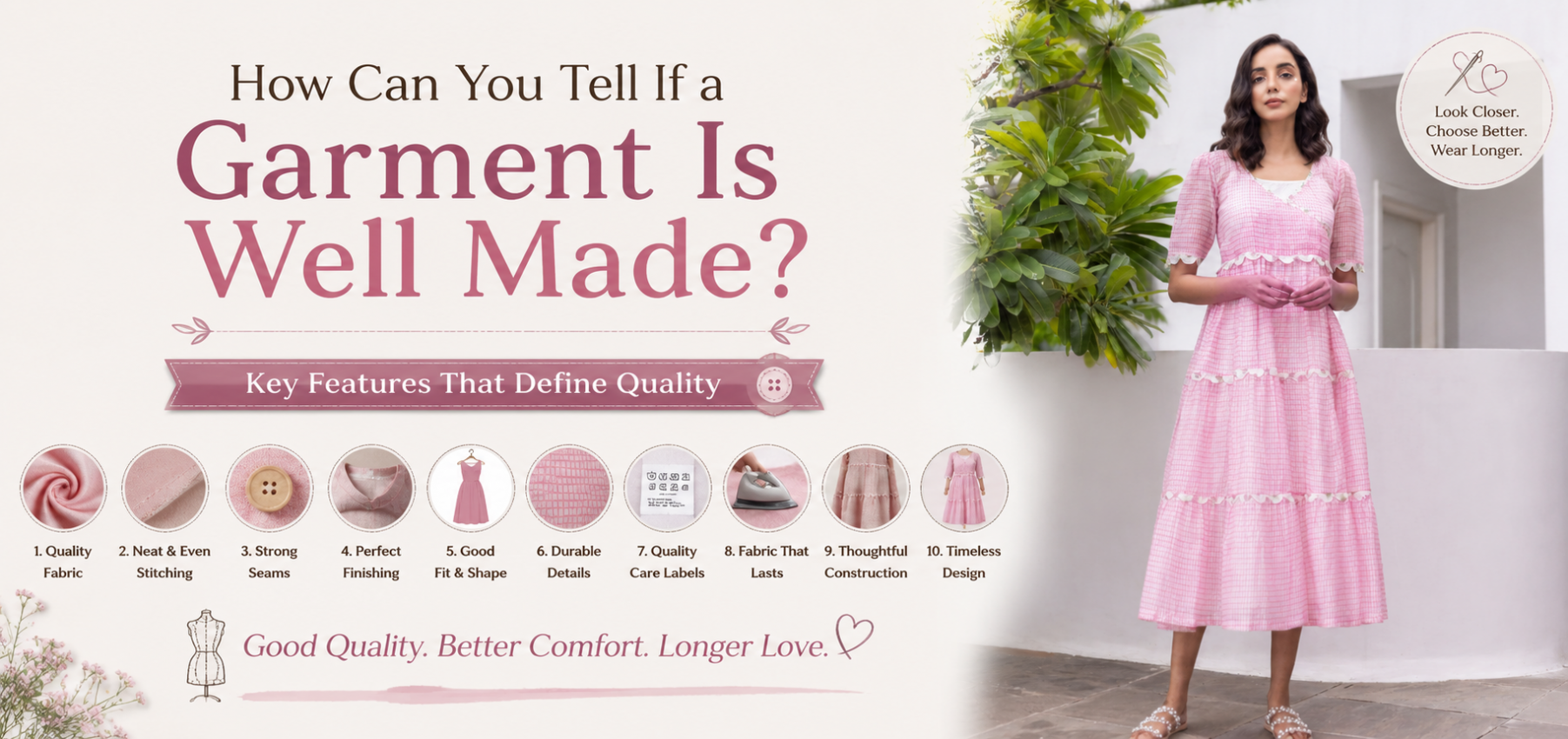
How Can You Tell If a Garment Is Well Made?
A price tag rarely tells the whole story. Two dresses can look identical on a screen, yet one will hold its shape after five washes while the other loses its seams within weeks. Knowing how to check garment quality before you add something to your cart saves money, reduces returns, and keeps your wardrobe out of the landfill for longer. This guide breaks down exactly what to look for — fabric, stitching, construction, and finish — so you can shop with a trained eye rather than a guess.
What Does "Well-Made" Actually Mean?
A well-made garment is one where the fabric, stitching, and construction work together to hold their shape, colour, and structure through repeated wear and washing. It reflects deliberate choices at every stage — fibre selection, cutting, sewing, and finishing — rather than shortcuts taken to cut cost or time. In short, quality is consistency you can see and feel, not just a label.
Start With the Fabric
Fabric is the foundation of any garment, and it's the fastest way to judge quality in under a minute. Hold the material up to light, scrunch it in your hand, and check how quickly it recovers its shape — these three checks reveal more than any product description.
Natural Fibres vs Synthetic Blends
Cotton, silk, linen, and wool breathe, age gracefully, and typically survive more wash cycles than fully synthetic fabrics like polyester or nylon blends. Blends aren't automatically inferior — a small percentage of elastane in cotton, for instance, adds stretch without sacrificing breathability. What matters is transparency: a trustworthy listing will state the exact fibre composition, such as "100% cotton" or "70% cotton, 30% Chanderi silk," rather than the vague term "premium fabric."
Fabric Weight and Hand-Feel
Lightweight cotton for summer dresses should still feel substantial between your fingers, not papery or see-through under normal indoor light. Rub the fabric gently — quality material resists pilling and doesn't leave lint on your palm. If a fabric feels stiff with a slightly plasticky sheen, it's often a sign of heavy synthetic content or a low thread count dressed up with finishing chemicals.
Cotton also carries print exceptionally well, which is why a printed maxi dress in breathable cotton tends to outlast one made from a synthetic blend — the fabric holds the block-print pigment better wash after wash and doesn't develop the static cling common to polyester prints.
Stitching and Seams: The Real Test of Craftsmanship
Turn any garment inside out before buying it — this single step reveals more about quality than the outer finish ever will. Seams should lie flat, threads should be trimmed neatly, and there should be no visible puckering along the stitch lines.
Seam Allowance and Finishing
A well-constructed seam has enough fabric allowance (generally 1.5 to 2 cm) to prevent fraying and to allow for future alterations. French seams, overlocked edges, or bias-bound finishes indicate the manufacturer invested in durability rather than just speed. Raw, unfinished edges that fray the moment you touch them are a clear red flag, especially on woven fabrics like cotton and Chanderi silk.
Stitches Per Inch
Count the stitches along a one-inch stretch of seam: eight to twelve stitches per inch generally signals a well-made garment, while fewer than six often means the seam will loosen quickly. Uneven stitch length or skipped stitches — visible as small gaps in the thread line — point to rushed machine work or poor quality control during production.
Check the Construction Details
Construction quality shows up in the parts you don't immediately notice: linings, closures, and how a garment is put together beneath the surface. These details are where manufacturers most often cut corners to reduce cost.
Linings, Interfacing, and Structure
A lined dress should have a lining that sits smoothly without pulling at the seams, and any interfacing (used in collars, cuffs, or waistbands) should be firm without feeling like cardboard. Structured pieces such as a women's pleated dress depend heavily on this internal support — poor interfacing is exactly why some pleated garments lose their crisp fold after a single wash, while properly finished ones hold their pleats for years.
Buttons, Zips, and Closures
Buttons should be sewn with a thread shank (a small gap between the button and fabric) rather than sitting flush, which prevents them from popping off under tension. Zips should glide without snagging, and metal zips generally outlast plastic ones on garments meant for repeated wear. Give every closure a gentle tug — if it feels loose or wobbly straight out of the packaging, it will fail faster than you'd expect.
Print, Embroidery, and Embellishment Quality
Decorative details are often where mass production and handcraft diverge most visibly. On a printed garment, check both sides of the fabric — a genuine hand block print will show natural, slightly imperfect ink absorption on the reverse, while a machine-printed digital transfer usually sits flat on the surface with a sharper, more uniform edge.
For embellished pieces, examine the underside of the embroidery. On hand embroidered dresses, the reverse side typically shows visible thread work and slight variation between motifs — small evidence that each piece was worked by hand rather than run through an automated embroidery machine. Loose threads, glued-on sequins, or embroidery that feels stiff and scratchy against the skin are signs of lower-grade embellishment.
Fit and Drape: How a Garment Should Sit on the Body
A well-made garment is cut to complement the body's natural movement, not fight against it. Try the garment on and move — sit, raise your arms, walk a few steps — because drape and structure only reveal themselves in motion, not on a hanger.
Florals in particular depend on precise pattern-matching at the seams; a poorly cut piece will show the print jumping or misaligning at the side seam. Well-tailored women's floral dresses keep the motif continuous across panels, which is a small but telling sign that the pattern was cut with care rather than in bulk, mismatched batches.
Fabric Origin and Craftsmanship Matter
India's textile traditions offer some of the clearest examples of what deliberate craftsmanship looks like, particularly in handloom weaving. A genuine handloom fabric carries small, natural irregularities in the weave — a subtle unevenness that power-loom or machine-made fabric simply cannot replicate, since machines produce a perfectly uniform texture every time.
A handloom Chanderi saree, for instance, is traditionally woven in Chanderi, Madhya Pradesh, using cotton, silk, or a cotton-silk blend, and it often carries a Geographical Indication (GI) tag as proof of authentic origin. That subtle sheen and lightweight drape are a direct result of the specific yarn and weaving technique used — details worth checking for before buying any saree marketed as "handloom."
A Quick Checklist: How to Check Garment Quality Before You Buy
Use this five-step checklist as a fast, repeatable process every time you shop — online or in-store — to check garment quality before committing to a purchase:
- Read the fabric composition listed on the product page or care label, and confirm it matches what the fabric feels like.
- Turn the garment inside out to inspect seam finishing, stitch density, and thread trimming.
- Test every closure — buttons, zips, hooks — with a gentle tug to check for looseness.
- Examine prints and embellishments on both sides of the fabric for consistency and hand-finished detail.
- Try it on and move to judge drape, fit, and how the fabric behaves against the body.
Mass-Produced vs Handcrafted Garments: A Quick Comparison
Mass-produced garments prioritise speed and uniform output, while handcrafted pieces prioritise individual attention at each stage of construction. Neither is automatically "better" for every use case, but the differences show up clearly once you know where to look.
- Weave and print: Power-loom fabric is perfectly uniform; handloom fabric shows natural texture variation.
- Turnaround: Mass production favours speed and lower cost; handcrafted pieces take longer due to manual weaving, printing, or embroidery.
- Consistency across pieces: Machine-made garments are near-identical piece to piece; handcrafted garments carry small, intentional variations that make each piece unique.
- Longevity: Well-finished handcrafted garments, especially in natural fibres, often outlast fast-fashion equivalents by several wear-and-wash cycles.
Common Red Flags to Watch For
A few warning signs consistently point to poor construction, regardless of the garment type or price point. Loose or hanging threads at the seams, a strong chemical smell straight out of the packaging, and visible glue residue near embellishments are among the clearest indicators of rushed manufacturing.
Co-ordinated sets are especially worth checking for colour consistency between pieces — dye lots can vary in bulk production. A well-matched women's cotton co-ord set should show identical shade and print alignment between the top and bottom, since mismatched dye batches are one of the most common quality issues in coordinated fashion.
Bringing It All Together
Checking garment quality doesn't require expert training — it requires a five-minute habit of looking closer: at the fabric, the seams, the closures, and the finish on both sides of every print or embroidery detail. In India, where handloom weaving and hand block printing remain living crafts, these checks also become a way of recognising and supporting genuine artisan work over mass-produced imitations. A garment that passes these checks is one built to be worn for years, not just for a season.
Frequently Asked Questions
How can I tell if a fabric is good quality just by touching it?
Good quality fabric feels substantial without being stiff, resists creasing when scrunched in your hand, and springs back to its original shape quickly. It shouldn't feel papery, overly slippery, or leave a plasticky residue on your fingers. Natural fibres like cotton and silk generally feel cooler and more breathable to the touch than synthetic blends.
Why should I turn a garment inside out before buying it?
Turning a garment inside out reveals the seam finishing, stitch density, and thread trimming — details hidden by the outer fabric. Frayed raw edges, loose threads, or uneven stitching on the inside almost always predict how quickly the garment will fall apart with regular wear and washing.
What is a good stitches-per-inch count for clothing?
Eight to twelve stitches per inch generally indicates solid, durable construction on woven fabrics. Fewer than six stitches per inch often means the seam will loosen or unravel faster, particularly at stress points like underarms, waistbands, and pocket openings.
How do I know if embroidery or prints are handmade?
Check the reverse side of the fabric: hand embroidery shows visible thread work and slight variation between motifs, while machine embroidery looks uniform and flat on the back. Hand block prints show natural, slightly uneven ink absorption, whereas digitally printed fabric has sharper, more mechanically perfect edges.
Does a higher price always mean better garment quality?
Not necessarily — price often reflects brand positioning and marketing as much as material and construction quality. The checks that matter most are fabric composition, seam finishing, stitch density, and construction detail, all of which can be verified regardless of the price bracket a garment sits in.
-
 August 26th, 2026
 -
Natural vs Synthetic Fabrics: What Should You Know Before Buying?
August 24th, 2026 -
 August 24th, 2026
 -
 August 13th, 2026