
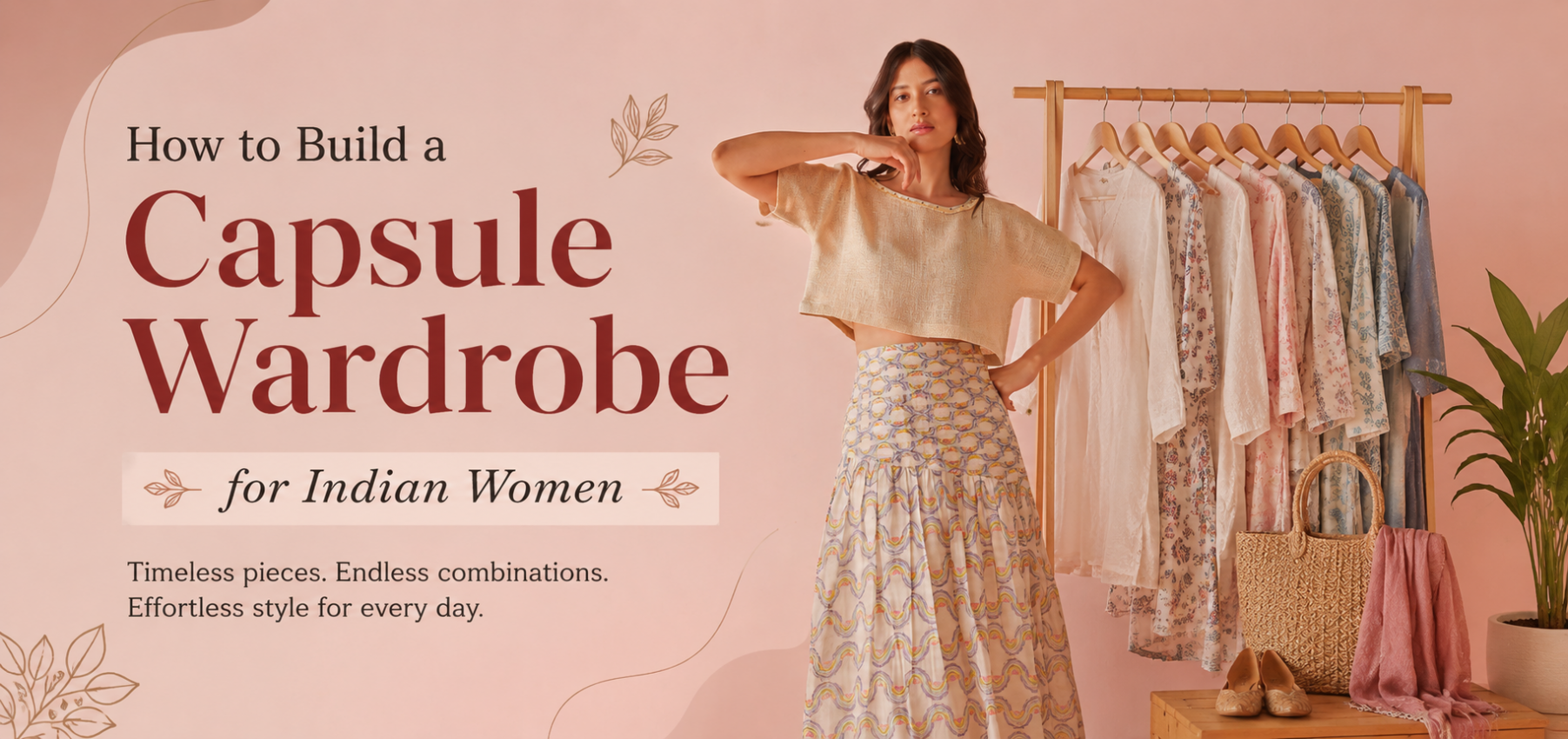
How to Build a Capsule Wardrobe for Indian Women
A capsule wardrobe for Indian women looks different from the minimalist, monochrome versions popularised in Western style guides. Indian dressing has to account for humid summers, a long festive calendar, regional textile traditions and workplaces that swing between formal and fusion. This guide breaks down how to build one that actually holds up through all of it.
What Is a Capsule Wardrobe?
A capsule wardrobe is a small, deliberately chosen set of clothing where every piece can be mixed and matched with several others, reducing the total number of garments needed without reducing outfit options. For Indian women, this usually means 25–35 versatile pieces spanning daily wear, workwear and occasion wear, built around two or three core fabrics and a limited colour palette.
Why the Western Capsule Wardrobe Formula Doesn't Translate Directly
Most capsule wardrobe guides are written for four-season, low-humidity climates and single-occasion dressing codes. Indian women deal with sustained heat and humidity across most of the year, a wedding and festival season that stretches from Navratri through to spring, and workplaces where the line between ethnic and Western dressing is often blurred rather than fixed.
This means fabric choice does more work in an Indian capsule wardrobe than colour coordination does. A cotton or handloom piece in 40°C weather earns its place in a way a synthetic blend in a "trendy" print never will, regardless of how well it photographs.
The Fabric-First Approach: Building Around Breathable Textiles
Start the wardrobe audit with fabric, not silhouette. Pure cotton, handloom cotton, Chanderi and cotton-silk blends absorb moisture and allow airflow, which matters more in a Delhi May or a Chennai August than any cut or colour decision. Hand block printed cotton, in particular, tends to soften with every wash rather than losing shape, which is why it survives repeat wear better than most synthetic prints.
Once two or three core fabrics are settled, the rest of the wardrobe logic — colour, print, silhouette — is easier to standardise, because everything is already working with the same washing, ironing and layering behaviour.
Core Pieces Every Indian Capsule Wardrobe Should Include
A working capsule doesn't need forty options in every category. It needs a small number of pieces that each pull double or triple duty across daily wear, work and festive dressing.
1. Everyday Cotton Dresses
One or two hand block printed cotton dresses in a relaxed silhouette cover office days, errands and casual outings without needing a second layer in most weather. Choose ankle or knee length depending on your usual dress code, and prioritise breathable cotton over anything with a high synthetic content.
2. A Wrap Silhouette for Instant Versatility
Wrap silhouettes flatter most body types and adjust easily between casual and semi-formal settings simply by changing footwear and accessories. If you're deciding where to spend your dress budget, cotton wrap dresses are usually worth the space they take up, since the tie-waist construction works for both a work lunch and a weekend outing.
3. Coordinated Sets for Low-Effort Dressing
Coordinated sets remove the guesswork of matching separates, which is exactly why they've become a staple in most working women's rotations over the last few years. If your wardrobe currently leans toward single dresses, women cotton co ord sets are worth adding next, since a top-and-bottom set in a breathable fabric can move from a desk to a dinner with a change of dupatta or jewellery.
4. Handloom Blouses and Tops
Blouses aren't only for sarees. A handloom or block printed top does the same job as a plain shirt but with more texture and less need for accessorising. For anyone building a fusion-heavy capsule, chanderi tops pair well with both cotton trousers and skirts, giving one piece at least three or four outfit combinations.
5. One or Two Occasion Pieces That Aren't Heavy Ethnic Wear
Every capsule needs a small allowance for weddings, festive get-togethers and family functions — but it doesn't need to be a lehenga. A tiered dress with a jacket layer photographs and wears like festive clothing while staying considerably lighter than traditional ethnic sets. Within this category, 3 piece jacket dresses are one of the more practical additions, since the jacket can be removed for a simpler look or kept on for a fuller festive silhouette from the same outfit.
6. A Layering Jacket or Shrug
A single well-cut jacket changes the formality of almost everything underneath it, which makes it one of the highest-value pieces in a small wardrobe. For someone who already owns a few plain kurtas or dresses and wants to stretch them further, a dress with jacket set is an efficient way to add a festive-ready layer without buying an entirely new outfit.
7. At Least One Statement Print
A capsule wardrobe built entirely from neutrals can start to feel flat by the third week. One printed piece — worn on its own or layered under a jacket — keeps the rotation visually interesting. A floral maxi dress or a similarly printed piece works well here, since it can be dressed down with flats for daytime or dressed up with heels and the jacket from your capsule for evening.
8. A Chanderi or Handloom Saree for Formal Occasions
Even a minimal wardrobe benefits from one or two handloom sarees kept aside for weddings and formal events where ethnic wear is expected. Chanderi sarees, with their characteristic light sheen and lightweight drape, tend to be more wearable across a full evening than heavier silk options.
How to Build the Wardrobe: A Step-by-Step Process
Building this kind of wardrobe works best as a short, structured process rather than a single shopping trip. The order below matters more than the shopping list itself, since starting with fabric and colour first prevents the wardrobe from turning into a random collection of unrelated pieces.
- Audit what you already own. Sort existing pieces by fabric and how often you've actually worn them in the last six months — not how much you liked them in the store.
- Choose two or three anchor colours. Pick shades that work across seasons and pair easily with each other, so new pieces don't need to be bought as isolated outfits.
- Fill category gaps, not general categories. Identify which of the eight core pieces above you're missing, rather than shopping by mood.
- Prioritise breathable fabric over trend. A well-fitting cotton or Chanderi piece will outlast a synthetic trend piece by several seasons.
- Add one or two festive pieces last. Occasion wear is the smallest category in a capsule, so it should be the last thing added, not the first.
Building a Capsule Wardrobe for Indian Women Across Seasons
This kind of wardrobe has to be re-thought seasonally rather than treated as a single fixed set, since most of India moves through summer, monsoon and a shorter, milder winter rather than four distinct seasons. Cotton and Chanderi pieces carry the summer and monsoon months, since they dry quickly and don't cling in humidity. Winter needs only a small addition — a couple of jackets or shrugs layered over existing dresses and tops rather than an entirely separate cold-weather wardrobe.
Festive-heavy months like October and November are worth planning for separately, since they're the only stretch of the year where occasion wear gets worn more than once or twice. Keeping one jacket dress and one saree already sorted before the season starts avoids last-minute shopping under time pressure, which is usually when budgets and fabric quality both suffer.
Common Mistakes When Building a Capsule Wardrobe
The most frequent mistake is treating "capsule wardrobe" as a synonym for "neutral wardrobe." Indian dressing has room for print and colour; the discipline is in versatility, not in avoiding colour altogether. The second common mistake is over-investing in occasion wear relative to daily wear — a wardrobe with ten festive pieces and three everyday options isn't a functioning capsule, regardless of how curated it looks. The third is ignoring fabric performance in favour of appearance, which usually shows up as pieces that look good on the hanger but get worn once and set aside because they don't hold up to Indian heat.
In Summary
At its core, this kind of wardrobe is built around breathable, handcrafted fabrics — cotton, handloom cotton and Chanderi — layered with one or two festive pieces rather than an entire ethnic wardrobe on standby. Roughly 25–35 pieces, chosen for fabric performance and cross-season versatility rather than trend, can realistically cover office days, casual outings and the festive calendar. The result is a wardrobe that's smaller to manage but doesn't feel smaller to wear.
Frequently Asked Questions
How many pieces should an Indian woman's capsule wardrobe have?
Most working capsule wardrobes for Indian women sit between 25 and 35 pieces, including dresses, tops, one or two sets, a couple of layering jackets, and one or two occasion pieces. The exact number depends on climate, work dress code, and how often festive events come up through the year.
What fabrics work best for an Indian capsule wardrobe?
Cotton, handloom cotton and Chanderi are the most practical base fabrics for Indian conditions, since they're breathable, absorb moisture and hold up to frequent washing. These fabrics also transition more easily between casual and semi-formal settings than synthetic blends do.
Can a capsule wardrobe include ethnic wear?
Yes — a well-built Indian capsule wardrobe should include at least one or two ethnic pieces, such as a handloom saree or a tiered jacket dress, reserved for festive and formal occasions. The rest of the wardrobe stays focused on daily and workwear.
How do I start building a capsule wardrobe without buying everything new?
Begin by auditing your existing clothes and keeping only what you've actually worn in the last six months. From there, fill specific gaps — like a missing layering jacket or an everyday cotton dress — instead of replacing the whole wardrobe at once.
Is a capsule wardrobe practical for Indian summers?
A capsule wardrobe is especially practical for Indian summers when it's built around breathable fabrics like cotton and Chanderi, since these pieces can be worn on their own without extra layers in high heat and humidity. The key is prioritising fabric over trend when choosing pieces.
-
 August 26th, 2026
 -

Natural vs Synthetic Fabrics: What Should You Know Before Buying?
August 24th, 2026 -
 August 13th, 2026
 -
 August 13th, 2026
