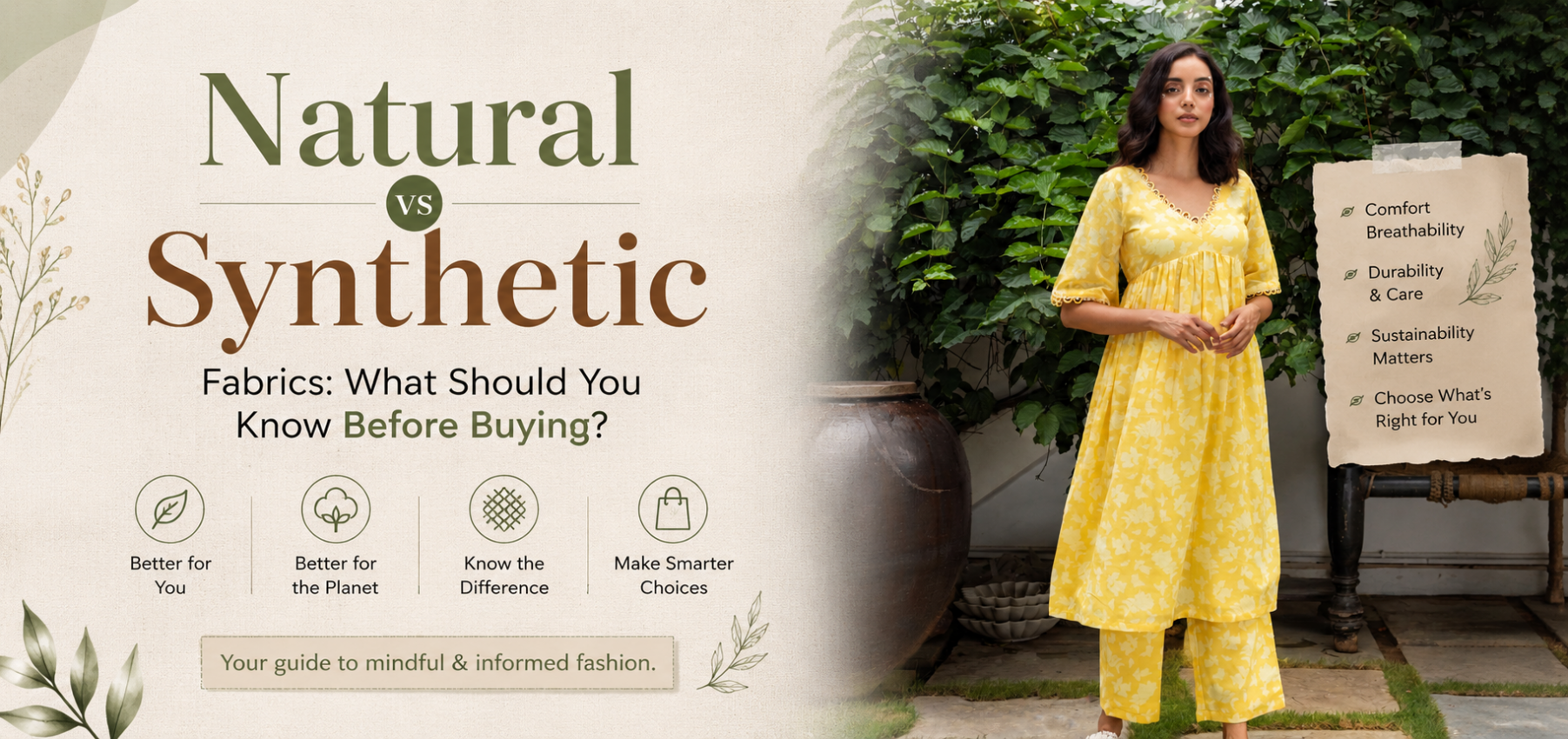
Natural vs Synthetic Fabrics: What Should You Know Before Buying?
Choosing clothing is often reduced to colour, fit, print and price, but the fabric can determine how comfortable and useful a garment actually becomes. Understanding Natural vs Synthetic Fabrics helps Indian shoppers make more informed decisions based on climate, occasion, durability, maintenance and personal preferences.
A natural fibre comes from a plant or animal source, while a synthetic fibre is manufactured through chemical processes, usually from petrochemical-based raw materials. Cotton, linen and silk are natural fibres; polyester, nylon and acrylic are common synthetic fibres. Neither category is automatically perfect for every garment, so the better choice depends on how and where you intend to wear it.
What Is the Difference Between Natural and Synthetic Fibres?
Natural fibres originate in nature, whereas synthetic fibres are engineered to achieve specific performance characteristics. The difference begins at the fibre level and influences breathability, moisture behaviour, texture, durability, appearance and care requirements.
For example, cotton is a plant-based cellulose fibre known for its absorbency and comfort. Linen is made from flax, silk comes from silkworm-produced filament, while wool comes from animal fibre. Polyester and nylon, on the other hand, are manufactured fibres designed for properties such as strength, wrinkle resistance and dimensional stability.
It is also important to distinguish fibre from fabric. Cotton is a fibre, while a particular cotton textile may have a specific weave, weight and finish. Two garments made from 100% cotton can therefore feel completely different because construction matters alongside fibre composition.
How Do Natural Fabrics Perform in Indian Weather?
Natural fabrics can be particularly comfortable in many parts of India because several commonly used natural fibres absorb moisture and allow air movement. However, performance still depends on the weave, fabric weight, garment construction and local climate.
India has remarkably different weather conditions. A lightweight cotton garment may be comfortable in Jaipur's dry summer heat, while a very absorbent fabric can remain damp longer in a humid coastal city such as Mumbai or Kochi. This means “natural” should not automatically be interpreted as “best for every weather condition.”
Cotton
Cotton is one of the most practical natural fibres for everyday Indian clothing. It is breathable, absorbent, relatively easy to maintain and available in many constructions, from lightweight muslin and mulmul to structured cambric and textured slub cotton.
The weave makes a significant difference. A loose, lightweight cotton can provide greater airflow than a dense cotton fabric. This is why checking the actual fabric description is more useful than relying only on the word “cotton” on a product page.
Linen
Linen is made from flax and is valued for its airflow, moisture absorption and characteristic textured appearance. It works particularly well for warm-weather clothing, although it can crease more readily than many synthetic alternatives.
That natural creasing is not necessarily a quality problem. For shoppers who prefer a relaxed, understated appearance, linen's texture can be part of its appeal.
Silk and Chanderi
Silk is a natural protein fibre with a smooth hand feel and distinctive lustre. Its suitability varies significantly according to the weave and garment construction, so silk is generally selected more for its combination of appearance, texture and occasion suitability than simply for summer performance.
Chanderi is another important textile in Indian dressing. Traditionally associated with Madhya Pradesh, Chanderi is known for lightweight construction and a subtle sheen. Its use in contemporary Indian clothing demonstrates how traditional textiles can work with modern silhouettes without relying exclusively on heavy embellishment.
What Makes Synthetic Fabrics Different?
Synthetic fibres are manufactured rather than harvested directly from plants or animals. Their major advantage is that manufacturers can engineer them for particular characteristics, including strength, stretch, wrinkle resistance, quick drying and shape retention.
Polyester is widely used because it is durable, comparatively inexpensive and resistant to wrinkles. Nylon is strong and lightweight, making it common in activewear, hosiery and functional garments. Acrylic is often used as a lighter alternative to wool, while elastane is valued for stretch and recovery.
These properties can be useful. A synthetic fibre is not automatically a poor-quality fibre, and there are situations where its performance advantages make it the practical choice.
When Can Synthetic Fibres Be Useful?
- When wrinkle resistance is a priority.
- When a garment needs substantial stretch or shape recovery.
- When quick drying is important.
- When high abrasion resistance is required.
- When a specific technical or performance finish is needed.
The limitation is that performance depends heavily on the individual fibre and fabric construction. A lightweight polyester designed for sportswear may behave very differently from a dense polyester fashion fabric.
Natural vs Synthetic Fabrics: Which One Is Better for Everyday Clothing?
There is no universal winner. Natural fibres are often preferred for breathability, texture and everyday comfort, while synthetic fibres can offer durability, stretch, easy maintenance and faster drying. The right decision depends on the garment's purpose rather than the fibre category alone.
Factor | Natural Fibres | Synthetic Fibres |
Common examples | Cotton, linen, silk, wool | Polyester, nylon, acrylic, elastane |
Moisture behaviour | Often absorb moisture, depending on fibre and weave | Often lower absorbency; behaviour varies by fibre and finish |
Breathability | Often very good in lightweight constructions | Varies considerably by construction and finish |
Wrinkle resistance | Usually lower | Often higher |
Stretch | Usually limited unless blended or specially constructed | Can be engineered for significant stretch |
Drying speed | Often slower when highly absorbent | Many types dry relatively quickly |
End-of-life behaviour | Some natural fibres are biodegradable under suitable conditions | Most conventional synthetics persist for much longer |
The important point is that fibre composition is only one part of fabric performance. Yarn thickness, weave density, finishing, garment lining and silhouette can all change how an outfit feels during actual wear.
Which Fabric Should You Choose for India's Climate?
The best fabric for India depends on both the region and the season. Dry heat, humidity, monsoon conditions and cooler northern winters create different clothing requirements, so a single fabric rule cannot work nationwide.
For Hot and Dry Weather
Lightweight cotton and linen are practical choices because they can provide airflow without excessive weight. Relaxed silhouettes can further improve comfort by creating space between the garment and the skin.
For a polished everyday wardrobe, breathable separates can be particularly versatile. For example, chanderi tops can introduce a lightweight traditional textile into contemporary styling without requiring a heavily embellished outfit.
For Humid Weather
Humidity changes the equation because sweat evaporates more slowly when the surrounding air already contains substantial moisture. Lightweight, breathable fabrics and loose silhouettes are generally more comfortable than dense, heat-trapping garments.
However, highly absorbent fabrics can also remain damp for longer. During humid monsoon conditions, fabric weight, drying time and garment construction should therefore be considered together rather than judging a garment solely by whether it is natural or synthetic.
For Cooler Weather
Fabric selection can shift toward insulation and layering. Wool and heavier natural textiles can provide warmth, while synthetic technical fibres may offer lightweight insulation and moisture management in outerwear.
The best wardrobe is therefore not necessarily made from one fibre category. A practical Indian wardrobe can contain different materials selected for specific conditions.
How Should You Choose Fabric for Work, Travel and Occasions?
Start with the activity rather than the trend. A fabric that looks excellent for a two-hour dinner may not be comfortable for an eight-hour workday or a long train journey.
For Office Wear
Choose fabrics that balance comfort with structure. Cotton, linen blends and lightweight traditional textiles can work well when the garment needs to remain polished throughout the day.
Wrinkle behaviour is worth considering. If your commute involves several hours of travel, a highly crease-prone fabric may require more maintenance than you want.
For Travel
Prioritise comfort, versatility and maintenance. A garment that dries reasonably quickly, layers easily and can be styled in multiple ways can be more useful than one selected purely for appearance.
Coordinated outfits can simplify packing because individual pieces can often be worn together or separately. A pair of women cotton co ord sets can work as a complete outfit while the individual pieces may also be combined with other wardrobe staples.
For Festive and Occasion Dressing
Texture, drape and visual character become more important. Silk, Chanderi, handloom cotton and other traditional textiles can offer richness without necessarily requiring heavy ornamentation.
A layered silhouette can also change the personality of an outfit. A 3 piece jacket dresses outfit, for example, demonstrates how a jacket can add structure and occasion appeal to a dress while giving the wearer more styling flexibility.
How Can You Check Fabric Quality Before Buying Online?
Online shopping makes fabric evaluation more difficult because you cannot physically touch the garment. The most reliable approach is to combine the fibre composition, product description, weave information, care instructions and customer feedback instead of judging from photographs alone.
- Read the fibre composition: Look for specific percentages such as 100% cotton or a clearly stated cotton-polyester blend.
- Check the fabric name: Terms such as mulmul, cambric, linen, Chanderi or slub cotton provide more information than generic words such as “premium fabric.”
- Look at the weave and weight: A lightweight open weave generally behaves differently from a dense, heavy construction.
- Read care instructions: Care requirements can reveal whether the garment is delicate, colour-sensitive or machine washable.
- Check garment construction: Lining, seams, finishing and silhouette can affect comfort as much as fibre composition.
- Consider your use case: Ask whether you need the garment for commuting, home wear, travel, festivals or occasional use.
Do not rely on informal “burn tests” when evaluating clothing. They can damage fabric, create fire hazards and are unnecessary when a reliable fibre-composition label is available.
Are Fabric Blends Better Than Pure Fabrics?
A blend combines two or more fibres to achieve a particular balance of characteristics. For example, adding elastane can provide stretch, while combining cotton with a synthetic fibre may improve wrinkle resistance or durability.
Blends are therefore not inherently inferior to pure fabrics. The key is transparency. A garment described as cotton should clearly state whether it is pure cotton or a cotton blend, because the difference can affect how it feels, washes and performs.
For buyers who value natural fibres, the percentage matters. A garment containing 60% cotton and 40% polyester will not necessarily behave like a 100% cotton garment, particularly in hot and humid conditions.
What Are the Environmental Considerations?
Environmental impact cannot be judged simply by labelling a fibre “natural” or “synthetic.” Fibre production, water consumption, agricultural practices, dyeing, processing, transport, garment lifespan and disposal all contribute to a clothing item's overall impact.
Natural fibres can offer biodegradability advantages under appropriate end-of-life conditions, but some crops require significant water and agricultural inputs. Synthetic fibres can be durable and resource-efficient in some applications, yet conventional polyester and nylon are fossil-fuel-derived and can contribute to persistent textile waste and microfibre pollution.
The most practical principle is to buy thoughtfully, use garments for longer and care for them correctly. A durable garment that is worn repeatedly can be a more responsible purchase than an item bought frequently and discarded quickly, regardless of fibre category.
How Does Indian Craftsmanship Change the Fabric Experience?
Fabric is not only about fibre chemistry. Indian textile traditions demonstrate how spinning, weaving, dyeing, printing and finishing can change the character of the same underlying material.
Hand block printing is a useful example. In traditional processes, artisans use carved wooden blocks to apply motifs to fabric, with separate blocks generally used for different colours. The slight variations created by hand placement are part of the visual character of the craft. The Yellow Bow's Jaipur-rooted perspective connects contemporary silhouettes with Indian craft practices such as hand block printing and handloom textiles.
From a buying perspective, this means shoppers should look beyond the fibre label. A well-made cotton garment can differ significantly from another cotton garment because of yarn quality, weave, printing technique, finishing and construction.
Simple Fabric-Buying Checklist for Indian Shoppers
Before purchasing any garment, take a few seconds to evaluate the material against your actual lifestyle. This small habit can prevent many disappointing purchases.
- What is the exact fibre composition?
- Is the fabric suitable for the climate where I live?
- Will I wear it for several hours at a time?
- Does the weave suit the season?
- How will it behave after washing?
- Is it easy to iron and store?
- Does the garment need special care?
- Is the fabric appropriate for the occasion?
- Can I style the garment in more than one way?
- Am I buying it because it is useful or simply because it is trending?
For example, someone looking for a lightweight layered outfit may prioritise drape and breathability, while someone buying a travel garment may place greater importance on wrinkle resistance and quick drying. Neither choice is universally correct; the right fabric is the one that fits the intended use.
How Can You Build a More Versatile Fabric-Based Wardrobe?
A versatile wardrobe does not require choosing one fibre and rejecting every other option. Instead, create a small mix of fabrics that serve different purposes throughout the year.
Keep lightweight cottons for everyday summer dressing, textured natural fabrics for relaxed smart-casual outfits, and traditional textiles for occasions where drape and craftsmanship matter. For easy layering, a dress with jacket set can offer more than one styling option from a single coordinated purchase.
Similarly, an airy silhouette can make a bigger difference than the fibre label alone. A floral maxi dress in an appropriate lightweight fabric can provide freedom of movement, while the same silhouette in a heavy or poorly ventilated material may feel very different.
For wrap silhouettes, fabric choice is equally important because the garment sits close to the body while still allowing movement. Lightweight cotton wrap dresses can be particularly practical for warm-weather wardrobes when the construction and fabric weight are appropriate.
Frequently Asked Questions About Choosing Fabrics
Are natural fabrics always better than synthetic fabrics?
No. Natural fabrics such as cotton and linen can provide excellent comfort and breathability, but synthetic fibres can offer useful properties such as stretch, durability, wrinkle resistance and quick drying. The better option depends on the garment, climate, activity and personal preferences.
Which fabric is best for Indian summers?
Lightweight cotton is one of the most practical choices for Indian summers because it is breathable and absorbent. Linen and lightweight handloom textiles can also work well. However, fabric weight, weave, garment fit and local humidity should be considered because a dense natural fabric may be less comfortable than a lightweight construction.
Is polyester bad for your skin?
Polyester is not inherently harmful to everyone's skin, but some people may find certain synthetic garments uncomfortable, especially in hot and humid conditions. Tight construction, trapped moisture, friction and heat can contribute to discomfort. If a fabric causes irritation, choose a looser garment or a more breathable material.
How can I tell if clothing is made from natural fibres?
The most reliable method is to check the fibre-composition label. Look for specific terms such as cotton, linen, silk or wool and check whether percentages are listed. Product descriptions and care labels can provide additional information. Avoid relying solely on touch or informal home tests.
Are cotton blends better than 100% cotton?
Neither is universally better. A cotton blend can offer benefits such as improved wrinkle resistance, durability or stretch, while 100% cotton may be preferred for its natural feel and absorbency. Compare the fibre percentages and select according to how you expect the garment to perform.
What should I check before buying fabric online?
Check the fibre composition, fabric name, weave or weight information, care instructions, garment measurements and construction details. Also consider your climate and intended use. A clear description is more valuable than a vague claim such as “premium” or “luxury fabric” because it gives you information you can actually use.
Final Takeaway: Choose the Fabric for the Life You Will Live in It
The smartest fabric choice is not simply a decision between natural and synthetic fibres. It is a decision about comfort, climate, purpose, durability, care and how frequently you will wear the garment. Natural fibres can be excellent for breathable everyday clothing, while synthetic fibres have legitimate advantages when stretch, strength, wrinkle resistance or quick drying are important. Read the fibre label, understand the construction and choose according to your real lifestyle. The best garment is ultimately the one whose fabric performs well long after the purchase.
-
 August 26th, 2026
 -
 August 24th, 2026
 -
 August 13th, 2026
 -
 August 13th, 2026
