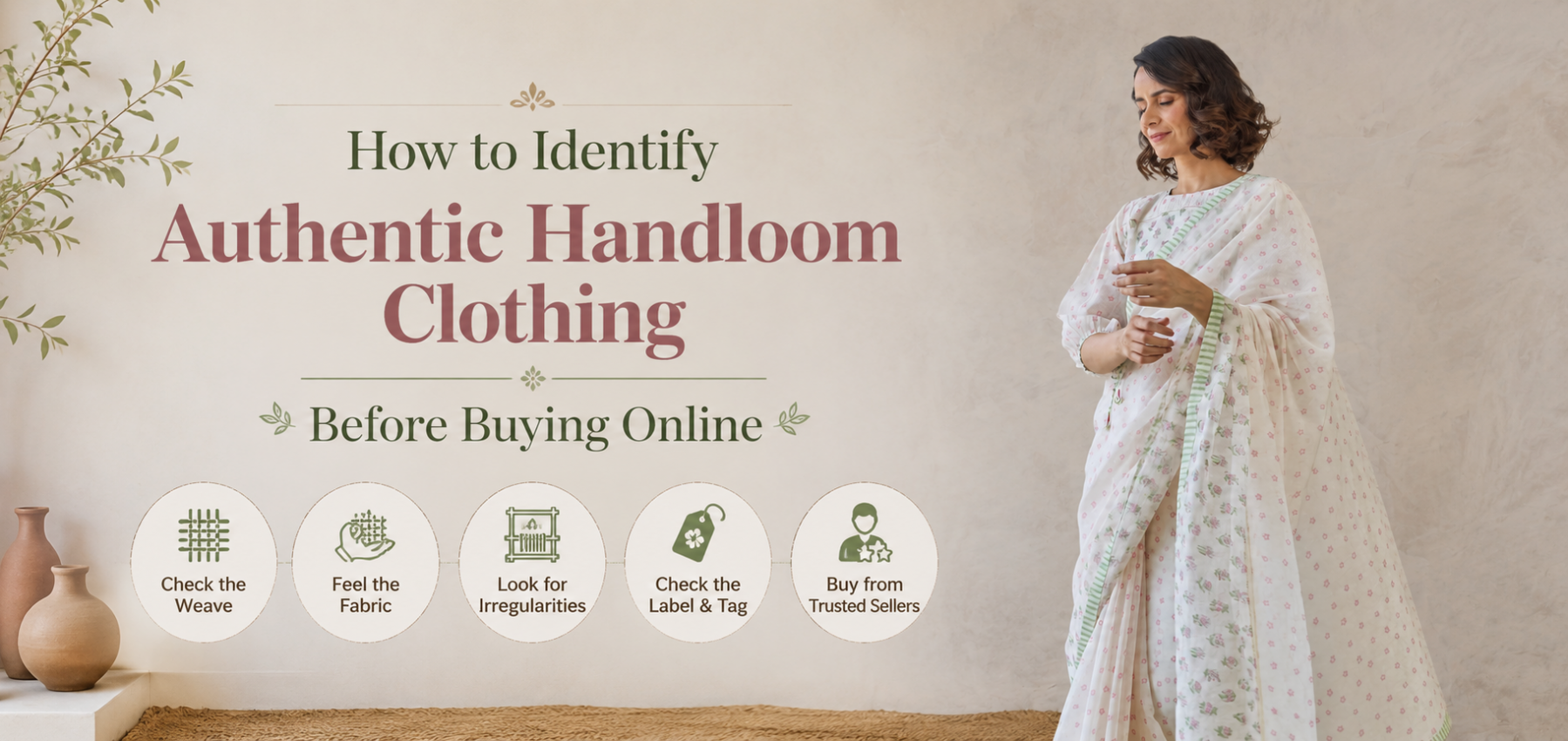
How to Identify Authentic Handloom Clothing Before Buying Online
India's handloom industry is one of the most extraordinary in the world — millions of skilled weavers across hundreds of regional traditions produce textiles that cannot be replicated by any machine. And yet, the online market is flooded with machine-made imitations that borrow the names, the aesthetics, and often the pricing of genuine handloom clothing — without any of the craftsmanship behind them. This guide gives you the exact knowledge you need to tell the difference before you buy.
Why Buying Authentic Handloom Clothing Actually Matters
The stakes in this conversation go beyond personal taste. When you buy a genuine handloom garment, you are participating in a supply chain that directly supports artisan families — weavers, dyers, and craftspeople whose livelihoods depend entirely on sustained demand for their work. When you unknowingly buy a powerloom or machine-made imitation sold as handloom, that support never reaches the artisan.
India's handloom sector employs over 35 lakh weavers — making it the second-largest employment provider in the rural economy after agriculture. The craft traditions involved — Chanderi weaving in Madhya Pradesh, Jamdani in West Bengal, Pochampally Ikat in Telangana, Banarasi in Uttar Pradesh — represent centuries of accumulated knowledge. Each time a genuine handloom piece is bought and valued, those traditions survive. Each time an imitation takes its place, the incentive to weave diminishes.
Beyond economics, authentic handloom fabrics are simply better in quality. They breathe more naturally, last longer with care, and carry an individuality — a slight variation in weave, a unique repeat in print, a texture that shifts in different light — that no machine can replicate at scale. Learning how to identify handloom fabric correctly is one of the most valuable skills a conscious Indian shopper can develop.
The Most Reliable Physical Signs of Genuine Handwoven Fabric
When you receive a garment at home — or when you are examining it in a physical store — several characteristics reveal its true origin. These are not just helpful hints; they are the observations that experienced buyers, textile experts, and seasoned artisans rely on every day.
1. The Weave Has Minor, Beautiful Irregularities
This is the single most important sign. A handloom fabric, woven thread by thread by a human weaver, will always have minor irregularities — slight variations in the spacing between threads, occasional small knots, or a barely perceptible unevenness in the repeat of a motif. These are not defects. They are the fingerprints of handcraft.
A powerloom or machine-made fabric, by contrast, is mechanically perfect. Every thread is spaced with identical precision. Every pattern repeat is flawless. If a fabric looks too perfect — too uniform, too regular — that is often the strongest sign it was made by a machine, not a weaver.
2. The Reverse Side Tells a Different Story
Turn the garment over and examine the back of the fabric. On an authentic handloom piece, the reverse side will show loose thread ends, small knots where the weaver changed yarns, and a slightly less defined version of the motif or pattern visible on the front. In complex weaves like Jamdani or Chanderi with woven bootis, the floating threads on the reverse are a clear sign of handwork.
On powerloom fabrics, both sides tend to look mechanically sealed and clean. The reverse will mirror the front with a consistency that no handloom can achieve.
3. The Selvage (Edge) is Uneven, Not Perfectly Straight
The selvage — the finished lengthwise edge of the fabric — is another reliable indicator. Handloom selvages are slightly uneven or rough in texture. Because a human weaver controls the tension of the weft threads manually, the edge varies slightly across the length of the fabric. Powerloom selvages, produced under mechanical tension control, are perfectly straight, smooth, and uniform.
4. The Pinhole Test for Handloom Sarees
Handloom sarees are woven by pinning the fabric to the loom during weaving. This leaves a tell-tale sign: tiny pinhole marks along the edges of the saree. These pinholes, sometimes barely visible, are a classic authenticating feature that powerloom or mill-made sarees do not have — because they are not pinned to anything during production.
5. The Touch and Breathability Test
Hold the fabric against the light and feel its weight in your hands. Authentic handloom fabrics — particularly fine cottons and Chanderi — are soft, breathable, and have a natural drape that comes from hand-tensioned weaving. They feel alive in the hand. Powerloom fabrics often feel slightly stiffer, have a processed smell, and lack the subtle softness that comes from natural fibres woven without mechanical force.
Expert Touch Tip: Rub a corner of the fabric between your fingers briskly for a few seconds. Authentic silk-based handloom fabrics (like Chanderi) will feel warm — a property of natural silk. Art silk or synthetic imitations remain cool and may feel slightly slippery or plastic-like.How to Spot Genuine Handloom Fabric When Buying Online
Shopping for handloom clothing online adds an extra layer of challenge — you cannot touch the fabric or examine the reverse. But there are very specific signals to look for in product listings, photographs, and seller communication that reveal whether a claim of "handloom" is genuine.
Study the Close-Up Product PhotographsReputable sellers of authentic handloom clothing always provide close-up, high-resolution images of the fabric texture. In genuine handloom, these images reveal a slightly uneven weave — you can see the subtle variation in thread thickness and spacing. If product photos are only wide-angle lifestyle shots with no fabric detail images, treat this as a warning sign. The seller may be hiding the uniformity of a machine-made fabric.
Look for Artisan Information and Craft Origin DetailsAuthentic handloom sellers will almost always mention the weaving tradition, the region of origin, and sometimes the artisan community behind the fabric. A listing that says "Handloom Chanderi woven by cooperative weavers in Chanderi, Madhya Pradesh" is a very different proposition from one that says simply "Chanderi-style fabric." The specificity of craft narrative is itself a sign of authenticity — because sellers who work directly with weavers know these details and are proud to share them.
The Government of India's Handloom Mark is the official certification that a product was woven on a handloom. Sellers with genuine handloom inventory will mention this mark, display it in photos, or provide a certification card with the garment. Separately, a GI (Geographical Indication) tag certifies that the product comes from the specific region associated with that weave. Both are powerful authenticators; having either is reassuring, having both is ideal.
Evaluate the Price HonestlyA genuine handloom garment — particularly a saree or a dress in fine handwoven Chanderi — requires days to weeks of skilled weaving time. It cannot be priced the way a factory-produced item can. If a listing claims "authentic handloom Chanderi saree" at a price that seems dramatically low, it almost certainly is not authentic. Authentic handloom is not cheap to produce, and prices that seem too good to be true nearly always reflect a powerloom or synthetic imitation.
Read Customer Reviews — and Look at Customer PhotosGenuine reviews from buyers who photograph the garment they received are invaluable. Look for review images that show the fabric texture in natural light. Experienced buyers in the review section will often mention whether the weave matched expectations, whether the fabric felt authentic, or whether it appeared powerloom. Reviews that describe the fabric as "softer than expected" or mention the slight irregularities approvingly are a positive signal.
Ask the Seller a Direct QuestionBefore purchasing, message the seller and ask: "Can you tell me the weaving tradition, the loom type used, and whether this carries a Handloom Mark or GI certification?" An authentic handloom seller will answer this with detail and enthusiasm. A seller with machine-made inventory often gives vague, deflecting responses or cannot provide specifics about weave construction. The quality of a seller's response to this question is one of the most reliable authenticators available to an online shopper.
Handloom vs Powerloom: A Side-by-Side Reference
Feature | Authentic Handloom | Powerloom / Machine-Made |
Weave Texture | Slight irregularities; variations in thread spacing | Mechanically perfect; uniformly regular |
Reverse Side | Loose threads, knots, floating motif threads visible | Neatly sealed; mirrors front precisely |
Selvage (Edge) | Slightly uneven or rough texture | Perfectly straight and smooth |
Feel | Soft, breathable, natural drape | Often stiffer; may feel slightly processed |
Pattern Repeat | Minor variations between repeats | Identical across entire length |
Pinholes (Sarees) | Present along edges | Absent |
Certification | Handloom Mark / GI Tag available | No such certification possible |
Price | Higher — reflects skilled labour and time | Lower — reflects machine efficiency |
Longevity | Very durable with proper care | Often less durable over time |
Fabric-Specific Authentication Tips for Popular Indian Handloom Textiles
Different handloom traditions have specific characteristics that help authenticate them. Here is what to look for in the most commonly bought handloom fabrics in Indian women's fashion.
Chanderi: The Lightweight Festive Weave
Chanderi is one of the most commonly imitated handloom fabrics in the Indian market. Authentic Chanderi — whether in saree or dress form — has a gossamer-light quality, a natural sheen from the silk warp, and crisp yet airy drape. The woven motifs (bootis) on authentic Chanderi are slightly raised from the fabric surface and visible on the reverse as floating threads.
Machine-made "Chanderi-type" fabric tends to have a uniform, flat sheen that looks similar at a distance but lacks the luminosity that shifts with the angle of light. The motifs are printed or mechanically woven without the raised texture that characterises hand-weaving. A handloom chanderi saree from a craft-focused brand that sources directly from Chanderi weavers will be clearly distinguishable from imitations in the texture of its weave alone.
Cotton Handloom: Everyday Wearability With Depth
Genuine handloom cotton — Jaipuri, Mul, or Kora — has a breathability and softness that machine-woven cotton cannot match. When held up to light, it has a slightly irregular transparency that reflects the hand-tensioned weave. The surface has a natural, lived-in texture rather than the pressed, uniform finish of mill-made cotton. A quality hand block printed dress in fine handloom cotton will show both the weave characteristics of authentic handloom and the print characteristics of genuine block printing — slightly uneven ink spread, minor variations at block edges — making two layers of craft authenticity visible in one garment.
Ikat and Jamdani: Where the Pattern Is the Proof
Ikat is one of the most technically challenging handloom traditions — the yarn is tie-dyed before weaving, and the pattern emerges from the alignment of dyed threads during weaving. The characteristic hallmark of authentic Ikat is a slightly blurred or feathered edge to the pattern. This is not a printing error; it is the natural result of warp and weft threads aligning during weaving. Machine-printed Ikat-look fabrics have sharp, hard-edged patterns that betray their printed (not woven) origin.
Block Printed Fabrics: Craft on Top of Craft
Hand block printing is a separate craft tradition from handloom weaving, but the two frequently combine. Authentic hand block printing, done with carved wooden blocks and natural or reactive dyes, leaves very specific visual signatures: slight variations in ink density across a print, minor misalignment between colour layers in multi-colour prints, and ink spread at the outer edges where the block was pressed harder. Digital prints and screen prints lack all of these characteristics — they are pixel-perfect and mechanically regular.
Red Flag to Watch: If a seller lists a garment as "handloom Chanderi" or "hand block printed" but the close-up images show absolutely perfect, uniform patterns with razor-sharp edges and zero variation — it is almost certainly a machine-made or digitally printed product. Perfection is the enemy of authenticity in handcraft.What Trustworthy Handloom Clothing Brands Do Differently Online
In a market where the word "handloom" is used loosely, the brands that genuinely work with artisans differentiate themselves in consistent, observable ways. Knowing these signals helps you shop with confidence.
Genuine craft-focused brands invest in detailed product photography that shows fabric texture at close range — not just lifestyle model shots. They provide information about weaving community, region of origin, and production process in their product descriptions. They are transparent about fabric composition, care instructions, and the people behind the pieces. They price honestly — which often means higher than fast fashion alternatives — and they explain why.
A brand rooted in artisan partnerships will also often describe specific collections around specific craft traditions. A tunic sets for women collection from a craft-first label, for example, will specify the fabric — whether it is block-printed cotton, Chanderi silk, or handloom cotton-modal — and explain the artisan tradition behind it, rather than describing the garment purely in terms of silhouette and colour.
Similarly, layering pieces like a golden shrug for women or occasion-wear sets like a dress with jacket set from authentic handcraft brands will clearly describe the fabric origin — Chanderi for the shrug, handloom cotton for the jacket — because the fabric is part of the value, not an afterthought.
Transparent return policies, responsive customer service that can answer craft-related questions, and a visible commitment to artisan welfare (rather than just discounts and sale events) are all consistent markers of brands that take handloom authenticity seriously.
Care Instructions as an Authenticity Signal
This is a point that almost no online guide mentions, and it is genuinely useful. Authentic handloom fabrics — particularly Chanderi sarees and fine cotton handloom garments — require specific, gentle care. Genuine sellers always provide clear care instructions: cold water wash, gentle detergent, shade drying, no wringing for silk blends.
If a garment claimed to be "pure handloom Chanderi" comes with care instructions saying it can be machine-washed on a regular cycle, that is worth questioning. Genuine Chanderi and fine handloom silks are delicate enough to require hand washing or dry cleaning, and brands that know their fabric know this and communicate it clearly.
A chanderi handloom saree from a credible artisan-focused brand will always include specific care guidance — because the brand values the fabric enough to help you preserve it.
A Quick Reference: Your Online Handloom Authenticity Checklist
Before You Buy — Check These 8 Things
- Does the seller provide close-up photos showing weave texture with visible minor irregularities?
- Is the region of origin and weaving tradition mentioned specifically in the product description?
- Does the listing mention a Handloom Mark, GI tag, or artisan certification?
- Does the price reflect the skilled labour and time involved in handloom production?
- Are customer review photos available that show the fabric texture in natural light?
- Can the seller answer a direct question about loom type, artisan community, and fabric composition?
- Are care instructions appropriate for the claimed fabric (gentle wash, shade dry)?
- Does the brand's story reflect a genuine artisan partnership, or is it purely marketing language?
Learning how to identify handloom fabric with confidence takes a little practice, but it becomes second nature quickly. The more you handle and study genuine handloom pieces, the more immediately obvious the difference becomes — both in person and in well-photographed online listings. Your attention to these details does not just protect your purchase; it actively supports the weavers, dyers, and artisan communities who make India's textile heritage one of the most extraordinary in the world.
Frequently Asked Questions
How do I know if a fabric is handloom or powerloom?
The clearest signs are slight irregularities in the weave (minor variations in thread thickness or spacing), small knots on the reverse side, uneven selvages, and a softer, more breathable feel compared to the stiff uniformity of powerloom cloth. Handloom fabric also carries subtle imperfections like a slightly skipped thread or uneven pattern repeat — these are marks of human craftsmanship, not defects. Powerloom fabrics are mechanically perfect and visually uniform.
What is the Handloom Mark and why does it matter?
The Handloom Mark is an official certification issued by the Government of India's Ministry of Textiles, confirming that a product was genuinely woven on a handloom by an artisan. When buying online, look for sellers who mention this certification or display it in their product listings. It is especially important for sarees, dupattas, and fabric lengths, where machine-made imitations are most prevalent.
Can I identify authentic handloom fabric from product photos online?
Yes, with careful observation. In genuine handloom fabrics, close-up product images reveal a slightly uneven weave texture, minor variations in thread spacing, and a natural surface quality. Machine-made fabrics photographed at the same zoom level appear flawlessly uniform. Also look for images showing the reverse side of the fabric — authentic handloom pieces show loose threads and minor knots on the back, which powerloom fabrics do not.
Is a GI tag the same as a Handloom Mark?
No — these are different certifications. A GI (Geographical Indication) tag certifies that the product originates from a specific region known for that craft — for example, Chanderi from Madhya Pradesh or Banarasi silk from Varanasi. The Handloom Mark certifies that the fabric was woven on a handloom rather than a power loom. A product can carry one, both, or neither — but having both is the strongest assurance of authenticity available.
Why is authentic handloom clothing more expensive than similar-looking alternatives?
A single handloom saree can take anywhere from two days to several weeks to weave, depending on complexity. The yarn is typically natural (cotton, silk, or a blend), and the process involves multiple skilled hands — from yarn preparation and dyeing to weaving and finishing. Machine-made alternatives replicate the look in hours. If a price seems too low for a claimed handloom piece, it almost certainly is not authentic — genuine handloom production simply cannot be priced like fast fashion.
-
 August 26th, 2026
 -
Natural vs Synthetic Fabrics: What Should You Know Before Buying?
August 24th, 2026 -
 August 24th, 2026
 -
 August 13th, 2026