
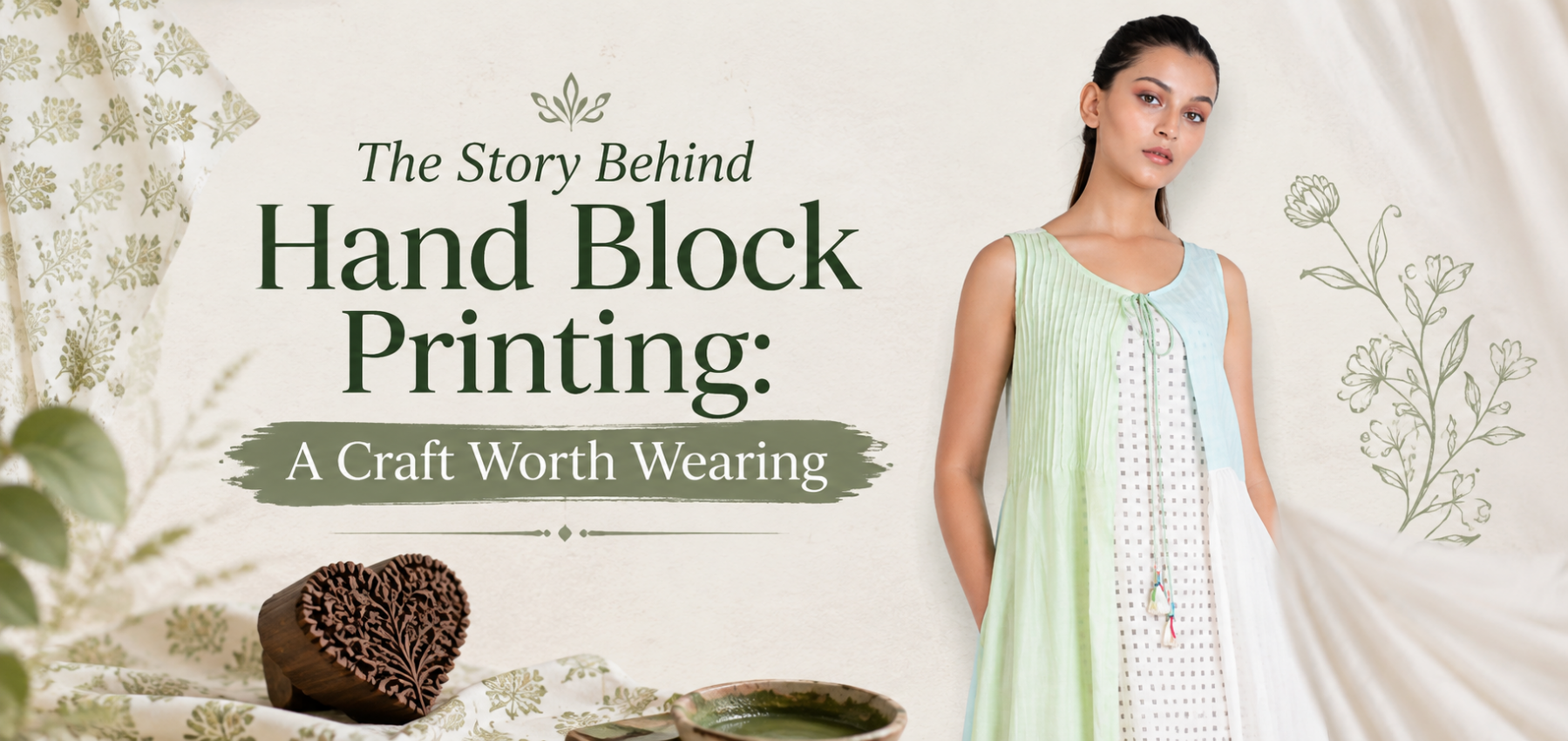
The Story Behind Hand Block Printing: A Craft Worth Wearing
Every printed cotton dress or saree carries a process behind it, and few processes are as deliberate as hand block printing. This centuries-old Indian textile craft turns hand-carved wooden blocks, natural pigments, and an artisan's steady hand into fabric that no machine can fully replicate. The story behind hand block printing is really the story of small workshops in Rajasthan and Gujarat, where families have carved and stamped patterns onto cloth for generations. Understanding this history changes how you look at a printed garment — it stops being just fabric and starts being a record of craft.
What Is Hand Block Printing?
Hand block printing is a textile technique where patterns are carved into wooden blocks, dipped in natural or pigment dye, and stamped by hand onto fabric, one motif at a time. Each colour in a design requires a separate block and a separate pass across the cloth. Unlike screen or digital printing, no two hand-printed lengths of fabric are ever perfectly identical, which is part of what makes the craft valuable.
The Origins: Where Hand Block Printing Began in India
Block printing in India is documented as far back as the 12th century, with Rajasthan's Sanganer and Bagru towns emerging as its most enduring centres. Both towns sit near Jaipur and are known for distinct printing styles — Sanganeri prints typically use a white or light background with fine floral motifs, while Bagru prints lean on earthy reds, blacks, and mud-resist patterns called Dabu.
The Chippa community, whose name comes from the Hindi word for "to print," has practised this craft as a hereditary occupation for centuries, passing carving and dyeing knowledge from one generation to the next. Gujarat contributes its own regional variant, Ajrakh printing, traditionally associated with Sindh and Kutch, recognisable by its deep indigo and madder-red geometric patterns. Both Sanganeri and Bagru hand block prints now hold Geographical Indication (GI) status, a legal recognition that ties the craft to its place of origin and protects it from being reproduced elsewhere under the same name.
How Hand Block Printing Is Made: A Step-by-Step Process
The process behind a single length of block-printed fabric involves several distinct stages, each done by a different specialist within the workshop.
- Fabric preparation: Cotton or Chanderi fabric is washed and treated to remove starch, so it absorbs dye evenly.
- Block carving: Skilled carvers, known as sikligars in some regions, hand-carve motifs into teak or sheesham wood, a process that can take days for a single detailed block.
- Dye preparation: Natural dyes are prepared from sources such as indigo, madder root, turmeric, and iron-rust solutions, depending on the colour palette of the design.
- Printing: The artisan dips the block in dye and presses it onto the fabric by hand, repeating the motif across the length in a continuous, aligned pattern.
- Layering colours: For multi-coloured designs, a fresh block is used for each additional colour, printed only after the previous layer has dried.
- Fixing and washing: The printed fabric is sun-dried, then washed to fix the dye and remove any excess pigment.
This sequence explains why a single block-printed saree or dress length can take anywhere from a few days to a few weeks to complete, depending on the number of colours and the intricacy of the design.
The Artisans Behind the Craft
Spend an afternoon at a block printing workshop in Bagru and the pace of the work becomes obvious — printers work in a steady rhythm, aligning each block stamp by eye against a small registration mark called a "gichi." A slight misalignment shows immediately in the finished cloth, which is why experienced printers are trained for years before they work on finer, multi-colour designs. Many workshops still use blocks that are decades old, some inherited across three generations of the same family, and it is common for a single motif to be traceable to a specific carver's hand.
This is also why hand block printed pieces carry natural variation. A slight shift in motif spacing or a faint colour difference between two dupattas from the same batch isn't a flaw — it's evidence that a person, not a machine, made the piece.
Hand Block Printing vs Machine Printing: What's the Difference?
The clearest way to understand the value of hand block printing is to compare it directly against machine or digital printing.
- Process: Hand block printing is stamped manually, motif by motif; machine printing uses rollers or digital heads to apply an entire pattern in seconds.
- Uniqueness: Hand-printed fabric shows natural, minor variations between pieces; machine-printed fabric is exactly repeated across the whole run.
- Dyes: Traditional hand block printing often uses natural, plant- or mineral-based dyes; machine printing typically relies on synthetic dyes for speed and colour consistency.
- Time and output: A hand-printed saree length can take days to weeks; a machine can print the same length in minutes.
- Livelihood impact: Hand block printing sustains artisan communities and traditional skills directly; machine printing is largely automated.
Neither process is "wrong," but they serve different purposes — machine printing suits mass production, while hand block printing suits garments where craftsmanship and provenance matter as much as the design itself.
Why Hand Block Printed Clothing Is Worth Wearing Today
In an era of fast fashion, hand block printed clothing offers something increasingly rare: a garment with a traceable human process behind it. Choosing block-printed cotton also tends to mean choosing breathable, natural fabric over synthetic blends, since the technique works best on cotton, silk, and handloom textiles like Chanderi.
A handloom chanderi saree finished with hand block motifs brings together two distinct crafts in one garment — the handloom weave of Chanderi, Madhya Pradesh, and the block-printed patterns of Rajasthan — making it a piece that reflects two regional textile traditions rather than one.
How to Identify Authentic Hand Block Prints
Authentic hand block prints usually show small, tell-tale signs that machine prints don't. Look closely at a few areas of the fabric before you buy.
- Slight irregularities: Minor variations in motif alignment or colour depth across the fabric length.
- Dye penetration: On lighter fabrics, the print is often visible, though softer, on the reverse side of the cloth.
- Colour depth: Natural dyes tend to look slightly muted rather than uniformly bright and flat.
- Repeat pattern: The motif repeat is close but rarely mathematically identical from one section to the next.
These aren't defects — they're the signature of a handmade process, and they're one of the clearest ways to tell a genuine block print apart from a printed imitation.
Caring for Hand Block Printed Garments
Hand block printed fabric, especially when dyed with natural colours, needs a little more care than standard printed cotton. Hand-washing in cold water with a mild detergent, avoiding prolonged soaking, and drying in shade rather than direct sunlight all help preserve both the colour and the print's fine detail over repeated wears. Ironing on the reverse side of the fabric also protects the printed surface from friction and heat damage.
Hand Block Printing Across Different Garments
The technique isn't limited to sarees. A chanderi tops collection printed with traditional block motifs shows how the craft translates well into contemporary, easy-to-style silhouettes, not just occasion wear.
Sarees remain one of the most popular canvases for the craft, and a printed chanderi saree is often where the contrast between handloom texture and hand-stamped pattern is most visible, since the sheen of Chanderi fabric changes how the printed motif catches light.
Co-ord sets have also become a practical way to wear this craft day-to-day. A set of women cotton co ord sets in hand block prints offers the breathability of cotton along with a coordinated, low-effort outfit that still carries the irregularities and character of handmade printing.
Layering pieces borrow from the same tradition, too. A golden shrug for women with block-printed or hand-embellished detailing can turn a plain kurta or dress into festive wear without the weight of heavier ethnic layers.
Embroidery is a separate craft from block printing but is frequently paired with it on the same garment. A collection of hand embroidered dresses often combines hand-stitched detailing at the neckline or hem with a block-printed body, giving a single piece two distinct handmade techniques.
Frequently Asked Questions
What is hand block printing?
Hand block printing is a textile technique in which patterns are carved into wooden blocks, dipped in dye, and stamped by hand onto fabric, one motif and one colour layer at a time. It originated in India and remains closely associated with Rajasthan's Sanganer and Bagru regions.
Where did hand block printing originate?
Hand block printing has been practised in India since at least the 12th century, with Rajasthan's Sanganer and Bagru towns near Jaipur developing into its best-known centres. Gujarat's Ajrakh printing is a related regional tradition. Sanganeri and Bagru prints now hold official GI (Geographical Indication) status.
How can I tell if a print is genuinely hand block printed?
Look for slight irregularities in motif alignment, muted rather than perfectly flat colour, and dye that's faintly visible on the reverse side of lighter fabrics. Machine-printed fabric, by contrast, shows an exact, mathematically repeated pattern with no variation across the length.
Why is hand block printed clothing usually priced higher than machine-printed clothing?
The price reflects labour and time: a single block-printed length can take days to weeks to complete, involving hand-carved blocks, natural dye preparation, and manual stamping for each colour layer. Machine printing completes the same length in minutes, which is the main reason for the price difference.
How should I wash and care for hand block printed fabric?
Hand-wash in cold water with a mild detergent, avoid long soaking, and dry the fabric in shade rather than direct sunlight to protect natural dyes. Ironing on the reverse side also helps preserve the printed surface over repeated washes and wears.
In summary: this handcrafted printing tradition is built on hand-carved wooden blocks, natural dyes, and artisan communities in places like Sanganer, Bagru, and Kutch, working through a slow, multi-step process that machine printing can't replicate. Each irregularity in a block-printed garment is a mark of that human process rather than a flaw. Choosing hand block printed clothing today means choosing a traceable, centuries-old craft over a purely mass-produced alternative.
-
 August 26th, 2026
 -

Natural vs Synthetic Fabrics: What Should You Know Before Buying?
August 24th, 2026 -
 August 24th, 2026
 -
 August 13th, 2026
